
2025 was a milestone year for Nordic car sales, with one record following another. Sweden, Denmark and Norway all ended the year with growth—especially Norway—while Finland faced another difficult year for its car market.
With 2025 behind us, it is time to take stock of the Nordic car market.
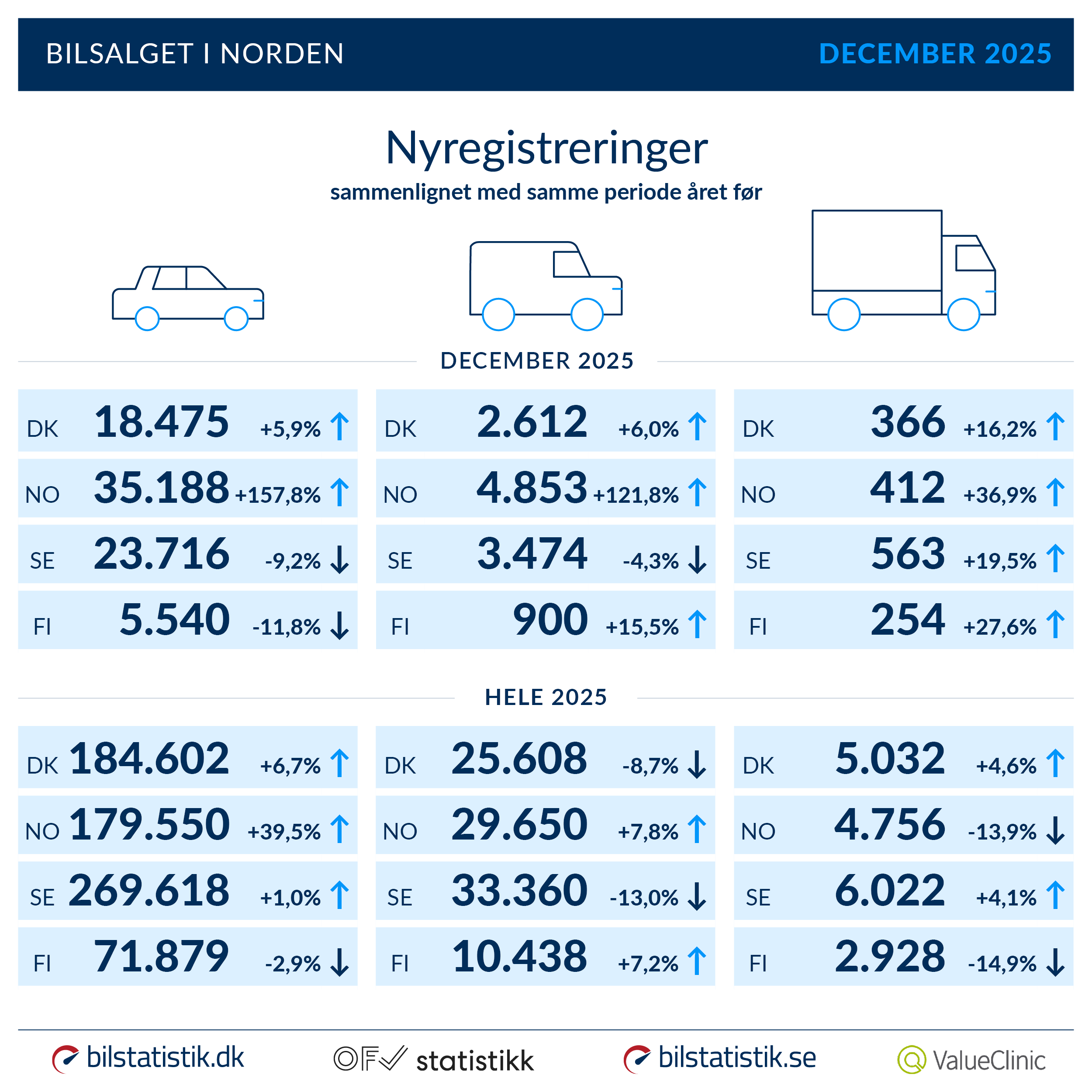
The final month of the year was remarkable enough to deserve a brief look first. Denmark, Sweden and Finland recorded relatively normal December passenger car registrations, respectively 5.9% above, 9.2% below and 11.2% below December 2024. Norway was a very different story.
Norway had already set records in November ahead of VAT changes due on 1 January, but December passenger car registrations surged even further. The 35,188 new registrations were 158% above December 2024. Never before had Norway registered so many cars in a single calendar month. Those two record months also produced the country’s highest annual registration total.
Geir Inge Stokke, CEO of Norway’s Opplysningsrådet for veitrafikken, says:
“2025 has been an extraordinary year for cars in Norway. We see the effect of a long-term, focused policy on electric cars and how specific tax decisions have an immediate impact on the market. The year-end rush was historically strong, and there is no doubt that the VAT change from 1 January 2026 prompted many people to secure a new electric car before the year was over.”
Mixed results for Sweden, Denmark and Finland
Elsewhere in the Nordics, the picture was less clear-cut. Denmark ended the year with 184,602 new passenger car registrations, up 6.7% from 2024. The country has not seen a level this high since 2021, although new registrations alone—excluding newer used imports—remain some way below pre-pandemic levels.
Sweden registered 269,618 new passenger cars, 1% fewer than in 2024. Apart from 2024 itself, we have to go back to 2013 to find a lower total, even though private registrations edged up in 2025. Andrée Peters, Director of Bilstatistik.se, says Sweden’s economic conditions continue to affect overall car sales:
“Sweden’s economic situation improved somewhat over the past year, and passenger cars registered by private individuals rose by 7%—albeit from a low level in 2024 (34.3%). Registrations by businesses, excluding car dealers, moved in the opposite direction and fell 3.7%. Vans had their weakest registration year since 2020, showing that the downturn continues to affect Swedish businesses. We expect it to continue through most of 2026.”
Finland registered 71,879 new passenger cars, down 2.9% from 2024, which had itself been a weak year. The CEO of Finland’s Value Clinic does not mince words about the 2025 results:
“2025 was clearly disappointing for new vehicle sales in Finland, especially passenger cars and trucks. Bright spots included the marked increase in the market share of fully electric passenger cars and the van market overall. Next year, we expect moderate growth in passenger cars, while vans and trucks are likely to remain around this year’s level. Much depends on an economy that has been stagnant for a long time; any improvement would certainly support new vehicle sales.”
The vehicle fleet grew greener across the Nordics in 2025
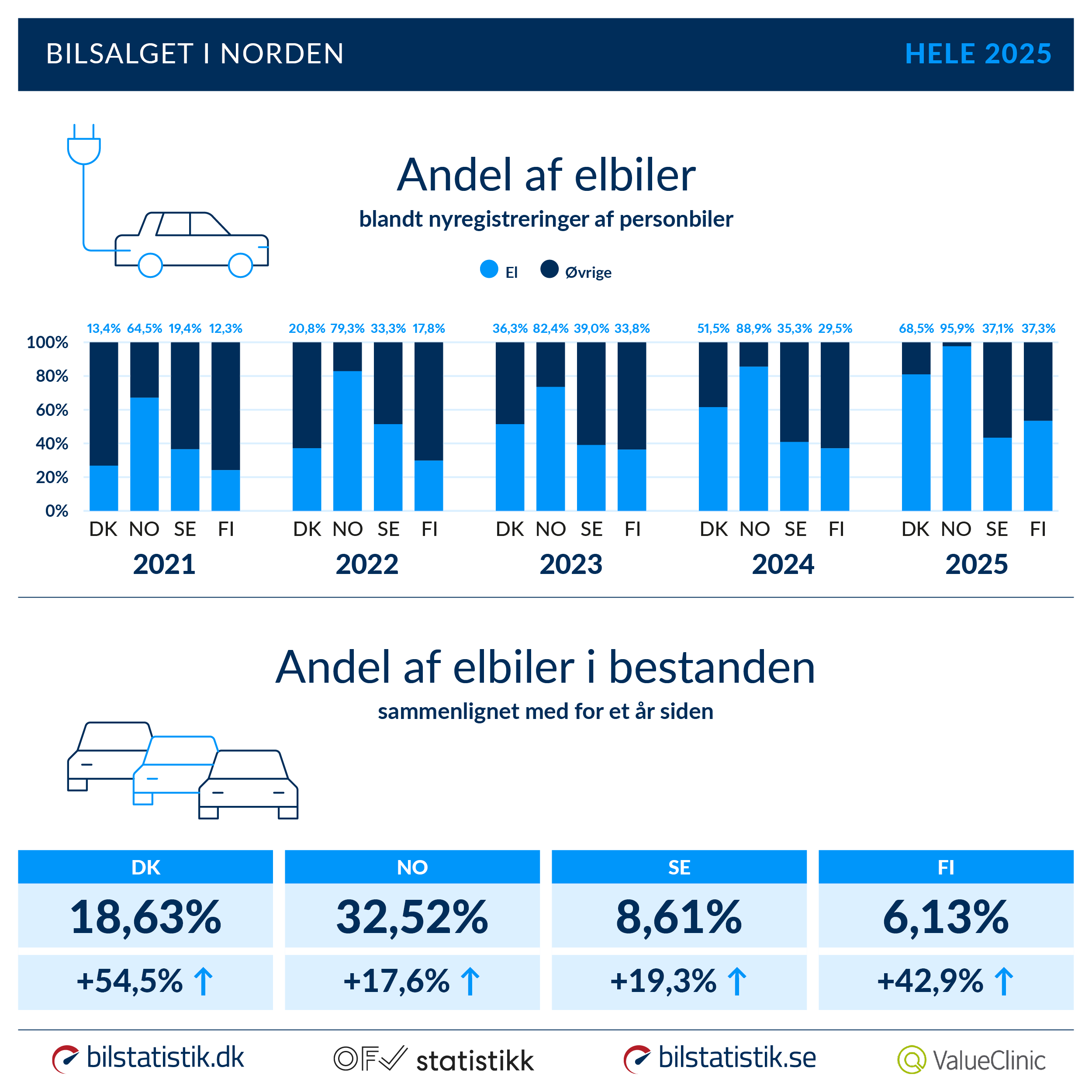
One trend was clear across all four markets in 2025: electric cars gained ground. Their share of new registrations rose everywhere after a 2024 in which it had fallen in Sweden and Finland. The pace of the transition differs sharply, however. Compared with full-year 2024, the figures are:
Denmark: 51.5% to 68.5% (+33%)
Norway: 88.9% to 95.9% (+7.9%)
Sweden: 35.3% to 37.1% (+5.1%)
Finland: 29.5% to 37.3% (+26.4%)
Norway again stands out with a new car market that is almost fully electric, while Denmark follows strongly with impressive growth. Mads Rørvig, CEO of Mobility Denmark, stresses that this reflects political priorities:
“The Nordic experience shows that the development of electric cars depends greatly on the policy framework. The Nordic countries have prioritised electric cars to very different degrees, and the results for 2025 show this clearly. In Denmark, the budget agreement has created good conditions for continued progress by maintaining the reduced registration tax on electric cars in 2026.”
The four countries’ electric car fleets are also changing rapidly. Denmark’s vehicle mix is shifting particularly quickly and clearly. More electric cars are entering the fleet through new registrations and record used imports, while increasing numbers of combustion-engine cars are scrapped or exported. As a result, the share of electric cars in Denmark’s fleet grew 54.5% in just one year, and the country passed 500,000 electric cars on the road earlier in 2025.
Clear model winners – but no shared favourite
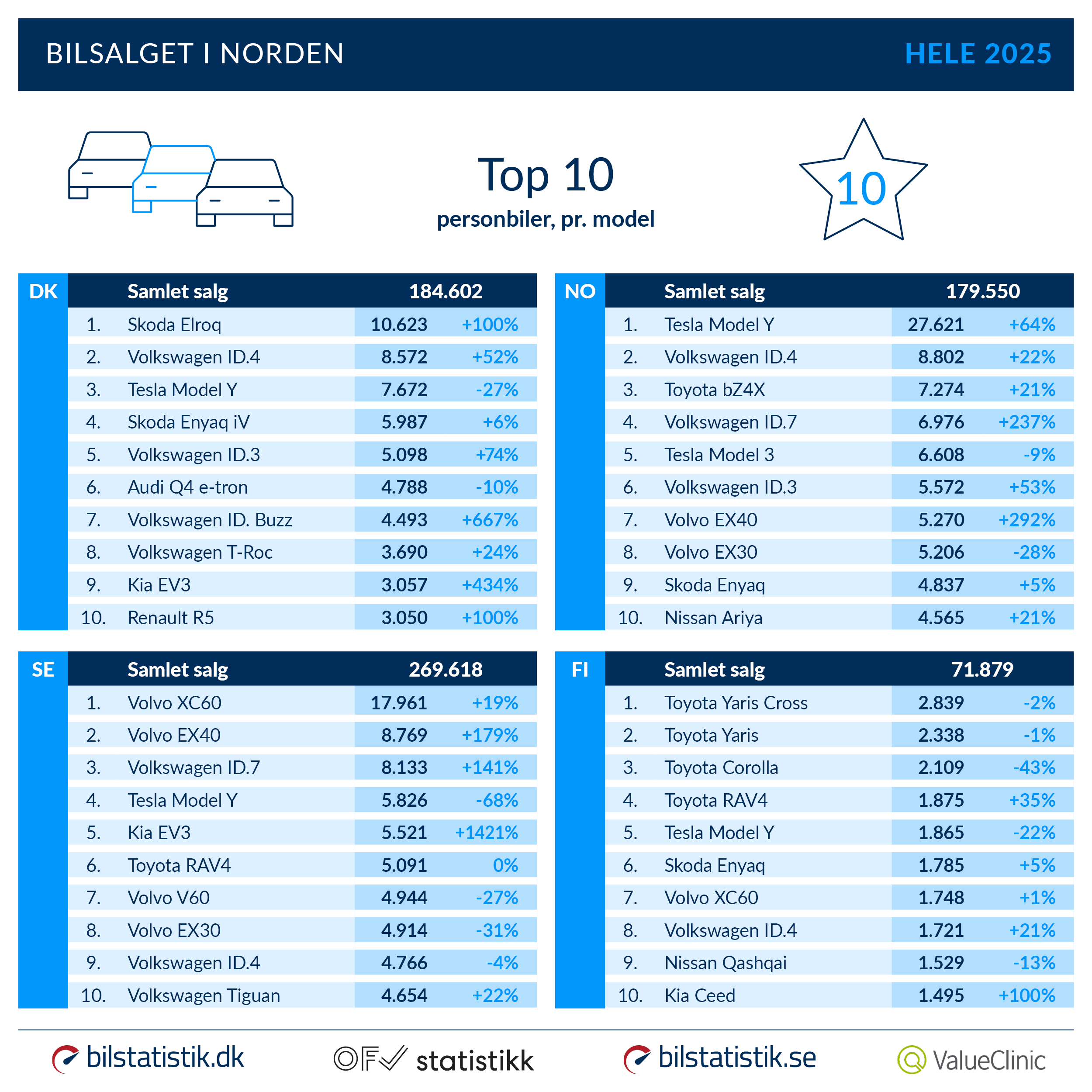
One thing the Nordic countries rarely agree on is their favourite models, as the 2025 rankings show. Only Volkswagen ID.4 and Tesla Model Y appeared in the top 10 in all four countries.
Norway and Sweden nevertheless had overwhelming winners. In Norway, Tesla Model Y dominated with 27,621 new registrations—more than three times as many as the second-placed Volkswagen ID.4. Sweden’s Volvo XC60 registered 17,961 units, more than 9,000 ahead of the second-placed Volvo EX40. Finland’s winner was less dominant, but preferences were still clear: Toyota occupied all four top places.
A mixed year for vans and trucks
2025 was a mixed year for heavier vehicles, although both vans and trucks finished strongly in December.
Norway again had the most striking van figures. After December registrations jumped 122% from 2024, the country ended the year up 7.8%. Finland followed: a 15.5% increase in December helped bring its annual result to +7.2%. Denmark and Sweden closed the year down 8.7% and 13%, respectively.
Truck registrations rose across all four markets in December, from 16.2% in Denmark and 19.5% in Sweden to 27.6% in Finland and 36.9% in Norway.
For the year as a whole, Denmark and Sweden recorded modest growth of 4.6% and 4.1%, respectively, while Norway and Finland saw declines of 13.9% and 14.9%.
Sharing data
Figures and data from this article may only be shared with the following source references:
Danish data: Bilstatistik.dk
Swedish data: Bilstatistik.se
Norwegian data: Opplysningsrådet for veitrafikken (OFV)
Finnish data: Value Clinic (Finnish Transport and Communications Agency Traficom, Transport Register)