The Nordic car market had an excellent first summer month. All four countries recorded growth in passenger car registrations in June, while Sweden and Norway also posted increases across passenger cars, vans and trucks.
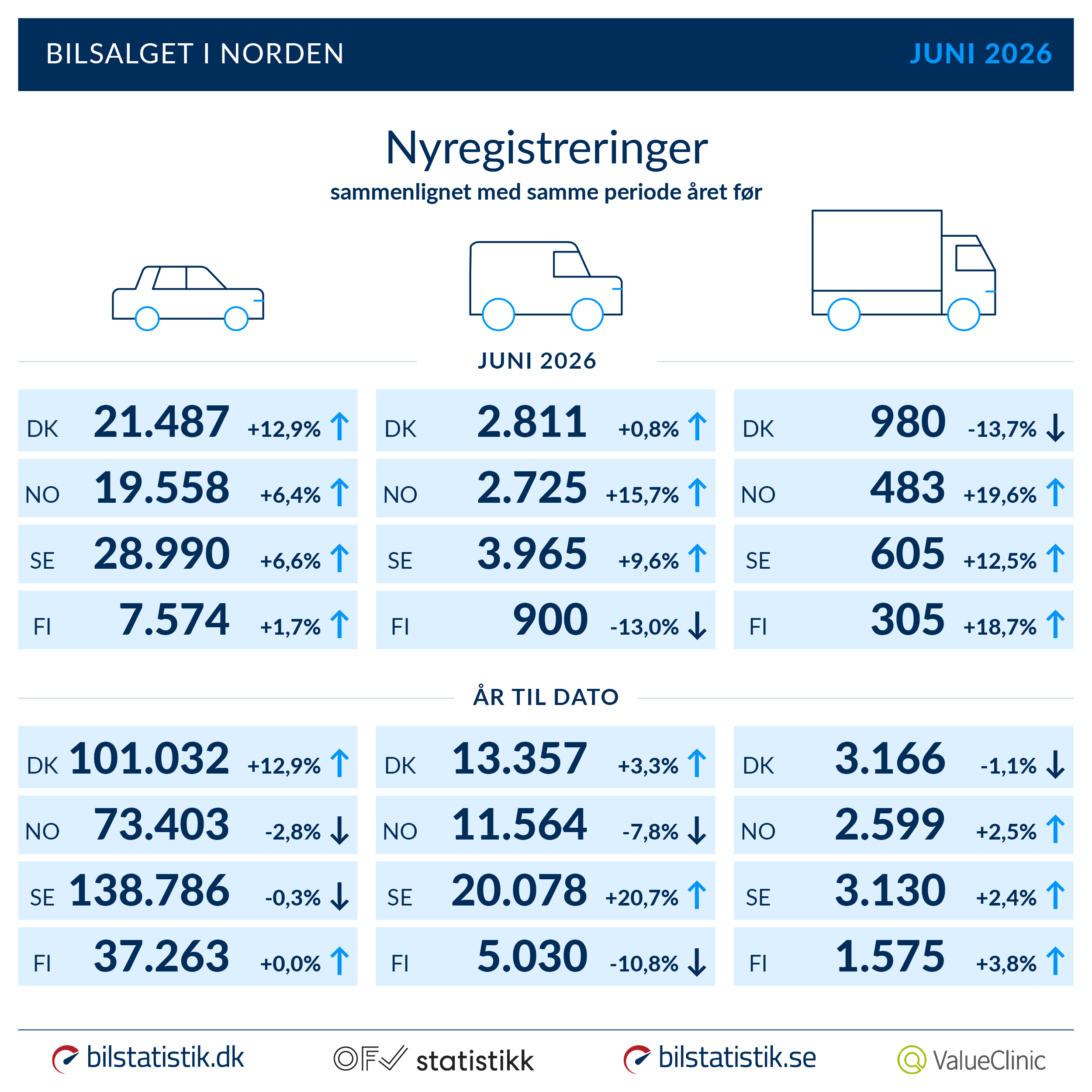
With 21,487 new registrations, the Danish market grew by 12.9% in June compared with June 2025. Sweden followed at +6.6% and Norway at +6.4%, while Finland, in keeping with the broader trend this year, recorded more modest growth of 1.7%. Denmark also led year-to-date growth, closing the first half of the year up 12.9%. Norway finished 2.8% below last year, Sweden 0.3% below, and Finland remained at the same modest level as in 2025.
Different conditions shape the electric car market
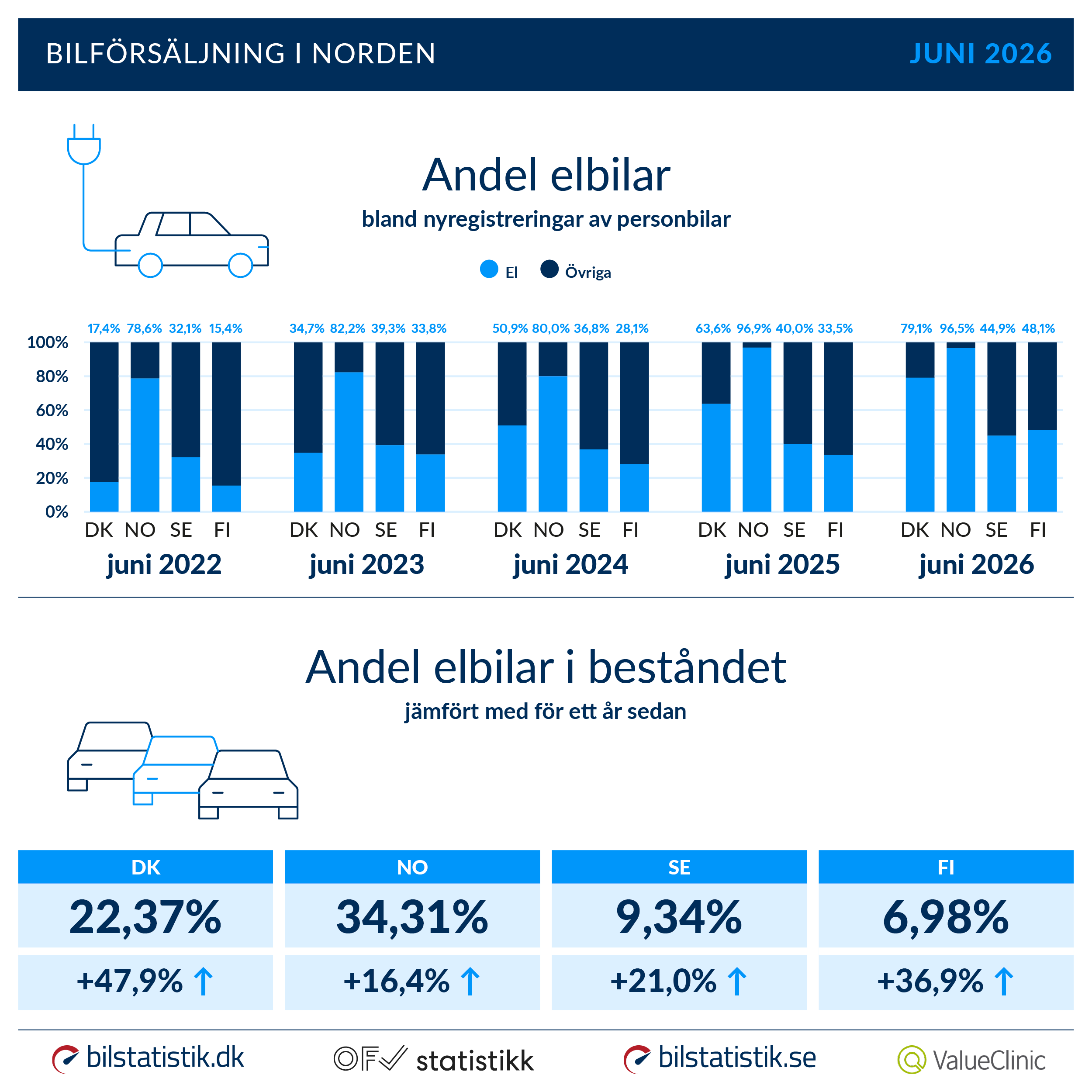
Electric cars also had a strong June, although Norway recorded the unusual sight of a slight decline in electric car share compared with June last year. The change is small: the share fell from 96.9% to 96.5%, a difference of only a few hundred vehicles. Norway’s new car market is effectively electric. Denmark is moving in the same direction: 79.1% of new registrations in June were electric, rising to 95.8% in the private segment. Finland and Sweden are also moving towards a greener mix, with electric car shares of 48.1% and 44.9% respectively. The figures also show how important stable framework conditions are to the transition. Jonathan Schacht Halling Nielsen, Deputy Director at Mobility Denmark, says:
“The Nordic figures show that electrification is progressing at different speeds. Norway remains the furthest ahead, but Denmark is clearly the second-most electrified new car market in the Nordics. This is largely because electric cars have become a genuinely affordable choice for many car buyers. That is why it is also crucial that this progress is not set back by higher registration tax on electric cars after the New Year.”
Despite some growth in electric cars, Swedish consumers already face more challenging conditions for the transition, and may encounter another obstacle from July. Andrée Peters, Director of Bilstatistik.se, says:
“The share of electric cars continues to rise in Sweden, and so far this year it is the large SUVs that are performing best (+57% and +4,899 vehicles). From 1 July to 30 September, however, the tax on both petrol and diesel will be reduced by SEK 3 per litre at the pump. It remains to be seen how this temporary support scheme will affect demand for electric cars, but we will of course follow developments.”
More similarities than usual in the top 10 lists
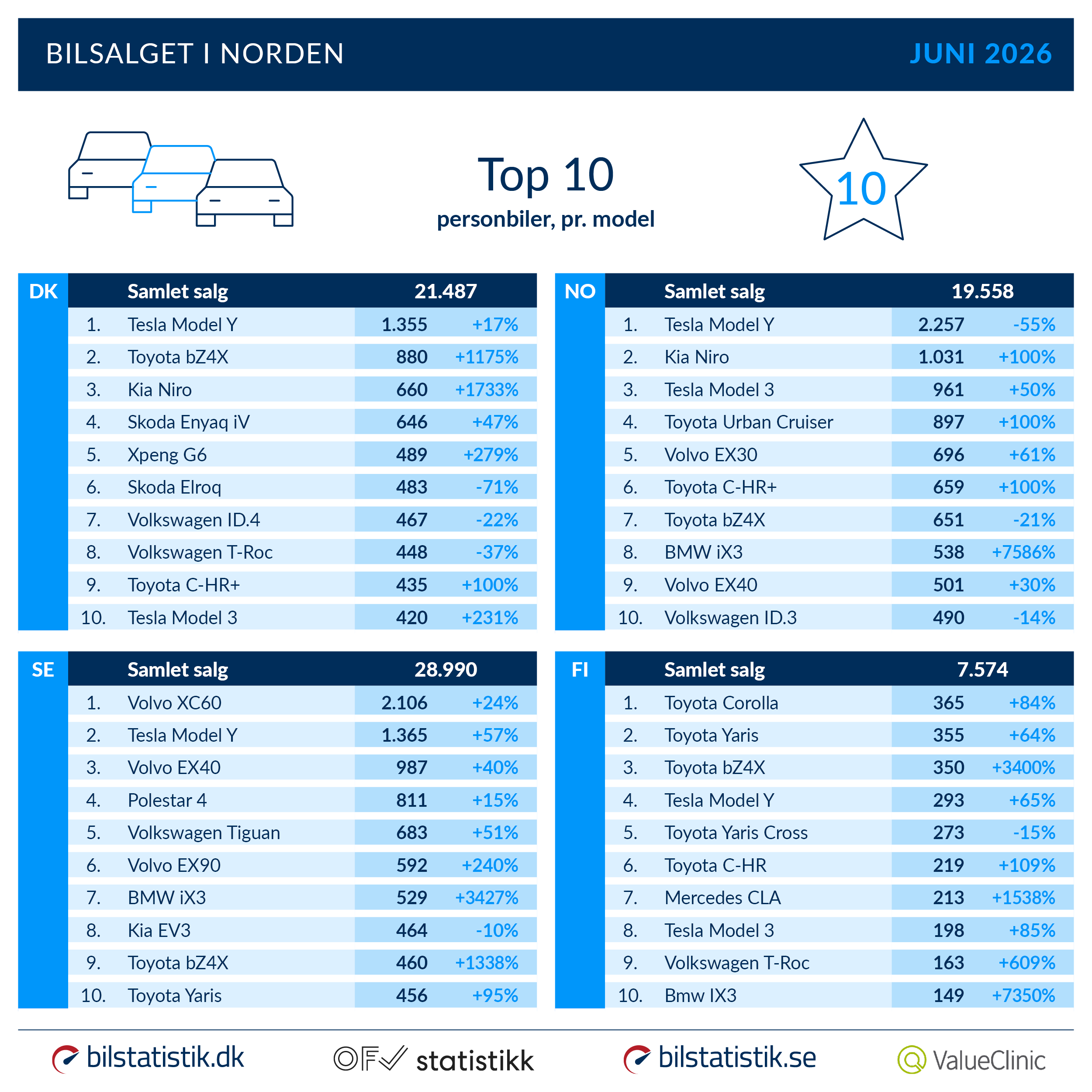
There is usually little overlap between the Nordic model rankings, but June brought a few shared favourites. The Model Y topped the lists in both Denmark and Norway, with a comfortable lead over the runner-up. It placed second in Sweden, behind Volvo as usual, and fourth in Finland. Toyota, a long-time favourite with Finnish buyers, took five of the ten places in June: first, second, third, fifth and sixth. Teemu Rennola of Finland’s Value Clinic comments:
“The most notable development in June registrations was Toyota’s growth of more than 70%—especially among electric cars, where registrations rose from 12 units the year before to 459.”
Toyota also had a very strong month in the other markets. The brand took two places in Denmark’s and Sweden’s top 10, and three places in Norway’s.
Another month of mixed results for heavy vehicles
Truck registrations reached a strong level in June in Sweden (+12.5%), Norway (+19.6%) and Finland (+18.7%), while Denmark ended 13.7% below June 2025. As a result, Denmark was the only market to finish the first half just below last year (-1.1%). The other Nordic markets edged above the line: Finland by 3.8%, Norway by 2.5% and Sweden by 2.4%. The picture for vans was more mixed. June ended with growth in Norway (+15.7%), Sweden (+9.6%) and Denmark (+0.8%), while Finland recorded a decline of 13%. For the first half of the year, the Nordics are split evenly: Denmark and Sweden are up 3.3% and 20.7%, respectively, while Finland and Norway are down 10.8% and 7.8%.
Sharing data
Figures and data from this article may only be shared with the following source references:
Danish data: Bilstatistik.dk
Swedish data: Bilstatistik.se
Norwegian data: Opplysningsrådet for veitrafikken (OFV)
Finnish data: Value Clinic (Finnish Transport and Communications Agency Traficom, Transport Register)