New registrations, used-car registrations, used imports and exports, and electric cars in the vehicle fleet: 2025 surpassed 2024 on almost every measure. Here we look at the most striking developments and how they have shaped Denmark’s vehicle fleet in 2026.
New registrations
New car sales are regaining momentum after years marked by the pandemic and supply shortages. With 184,602 new registrations, 2025 finished 6.7% above 2024, a level not seen since 2021. Whether Denmark will return to the more than 225,000 new registrations seen in 2019 remains to be seen. New sales now also face competition from another source of supply: used-car imports. More on that below.
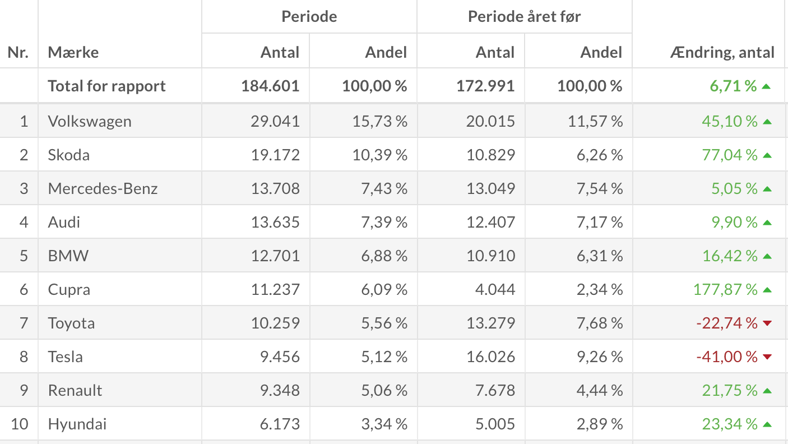
At the brand level, Semler has the most reason to be pleased with 2025. Its brands, led by Volkswagen, dominate the year’s top 10 and together account for about 40% of the market:
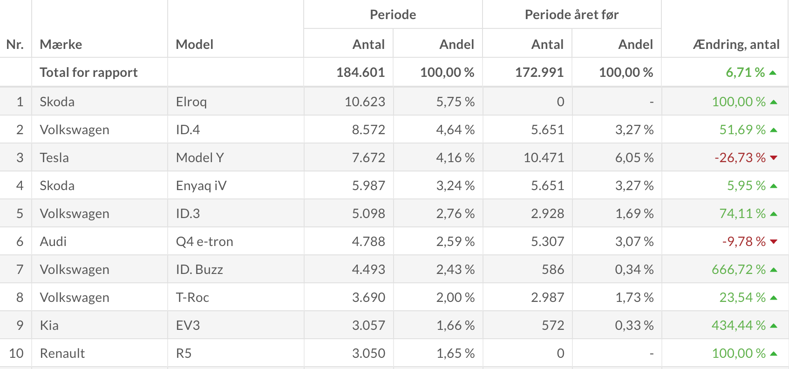
Semler also dominates at the model level. Škoda Elroq took first place, more than 2,000 new registrations ahead of the second-placed model:
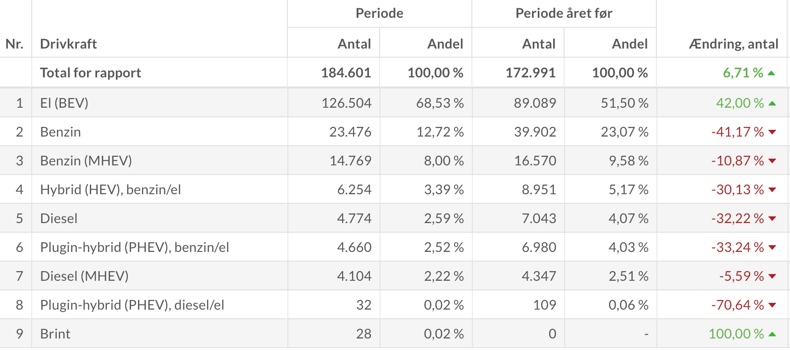
Powertrain preferences are even clearer than brand and model preferences. Electric cars accounted for 68.5% of all new registrations, led by private buyers, among whom 86% of newly registered cars were electric. The business segment trailed behind with an electric share of 41%.
Looking at how cars were financed in Denmark in 2025, leasing was almost as popular as it had been the year before. Private customers leased 38.5% of newly registered cars, compared with 40% in 2024. Businesses leased 87.1%, compared with 87.3% a year earlier.
Private users accounted for 60.9% of all newly registered cars in 2025.
Used-car imports
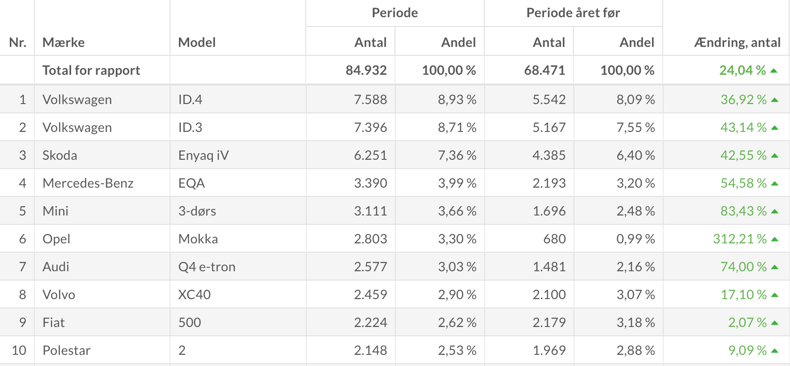
Used-car imports also produced remarkable figures in 2025. Denmark has never imported so many used cars in a single year. Volumes rose 24% from 2024 and 230% from 2020, while 92% of the imported cars were electric. The vast majority were also relatively new. Used imports may therefore be keeping new-car sales below the levels seen before this surge. Adding the number of new registrations in 2025 to imports of newer used cars, up to two years old, brings us very close to the level of the record year 2019.
These were the most popular models:
Used-car registrations
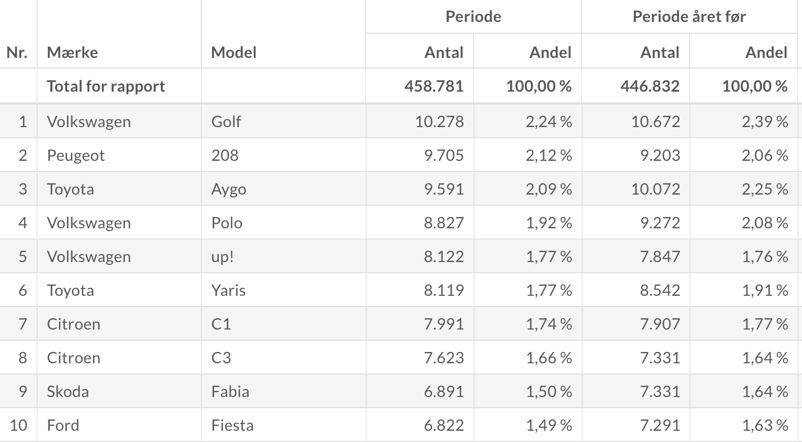
Used-car registrations, excluding used imports, changed relatively little from 2024. A total of 458,781 passenger cars were registered as used in 2025, up 2.7% from the previous year. The most traded models were largely the usual suspects in the used-car market:
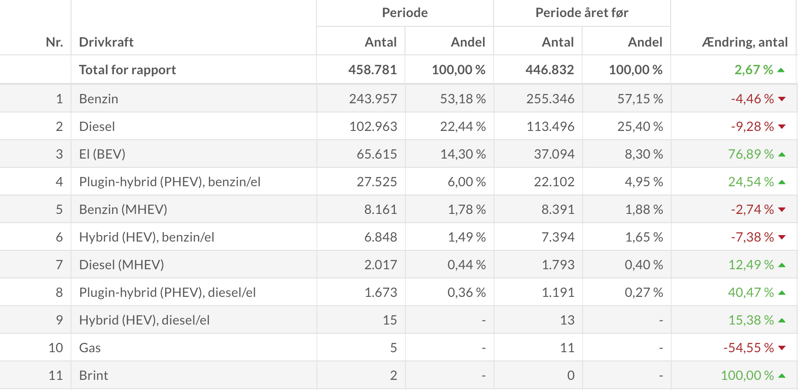
One thing that is changing in the used-car market is the choice of powertrain. Electric cars are reshaping the picture here too. More than 65,000 used electric cars were registered, up 77% from last year. The figure is five times higher than in 2022.
Exports
While electric cars are arriving on Danish roads through new sales and used imports, another type of car is leaving quickly: cars with combustion engines. Diesel cars in particular dominate exports.
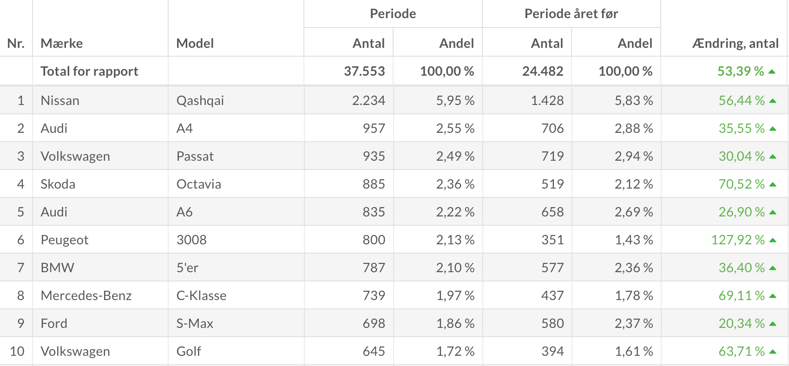
In 2025, export refunds were sought for 37,553 passenger cars, up just over 53% from the previous year. Diesel cars accounted for 60% of these export transactions and petrol cars for 34%. The remainder was split among plug-in, full and mild hybrids.
One curious detail in the model figures is that a single model was exported at a particularly high rate: more than twice as many Nissan Qashqais were exported as the second-placed Audi A4:
Scrappage
Scrappage in Denmark was almost unchanged from last year. The 68,465 cars scrapped in 2025 were about 2.5% fewer than in 2024, and nearly all were petrol or diesel cars.
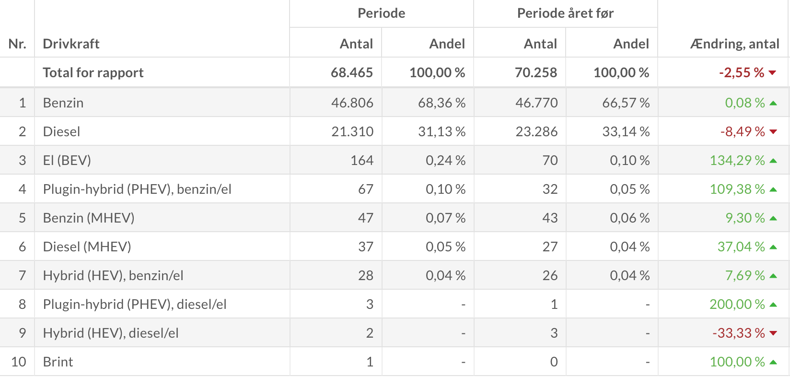
The vehicle fleet
Developments as substantial as these naturally change the fleet on Danish roads. The shift in powertrains is especially striking, as is the overall increase in the number of cars.
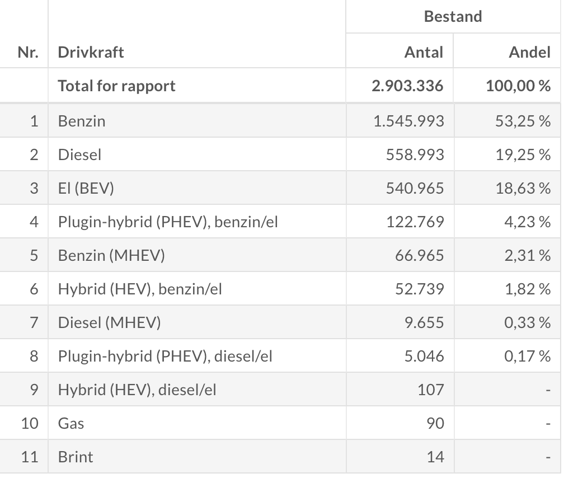
On 31 December 2025, Denmark had 2,903,336 registered passenger cars—47,590 more than a year earlier.
During 2025, the fleet gained 196,549 electric cars while losing 64,303 diesel cars and 83,203 petrol cars. New registrations and used imports account for the gains; used exports, scrappage and deregistrations account for the losses.
The overall powertrain mix is as follows:
Looking back just three years shows how quickly electric cars have gained ground and combustion-engine cars have declined.
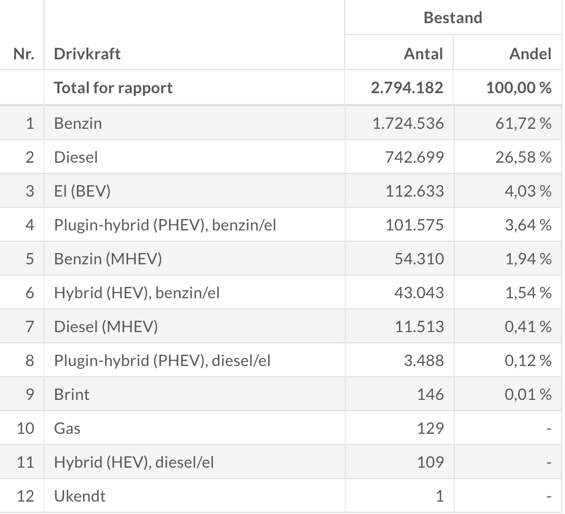
Since 2022, Denmark’s fleet has gained more than 428,000 electric cars while losing nearly 184,000 diesel cars and 179,000 petrol cars. That trend became even more pronounced in 2025.
Electric cars are now only a whisker away from overtaking diesel cars in the fleet.
With this brief look back at 2025, we wish everyone a happy New Year.