The end of the first quarter was strong in the Nordics. All four markets show growth for passenger cars, and electric car shares are rising across the board – including a new monthly record.
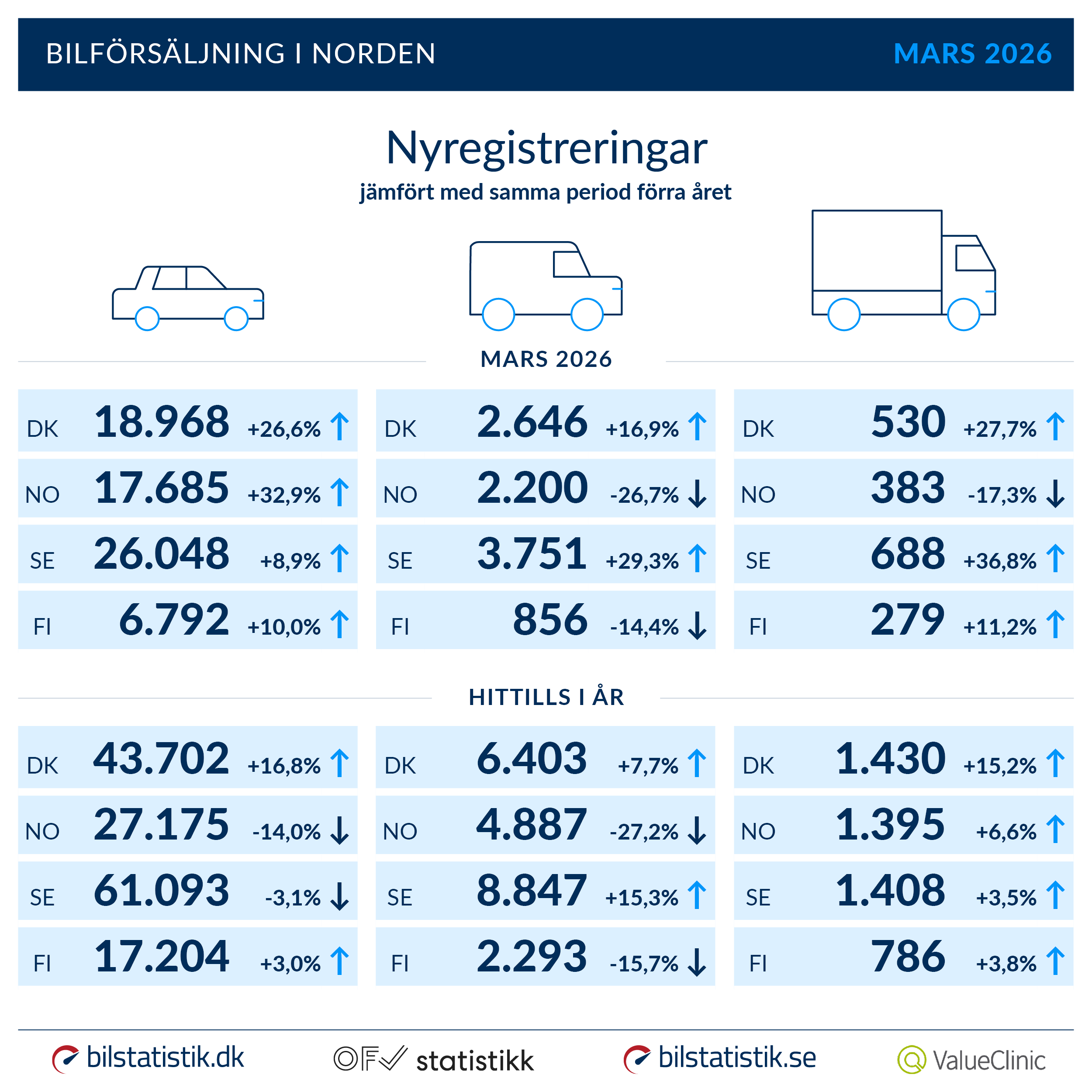
March was a very strong month for passenger car registrations in the Nordics. With 17,685 new registrations, Norway accounted for the biggest increase, at +33% compared with March 2025. Denmark follows, where 18,968 new registrations correspond to a rise of just under 27%. Finland also saw a long-awaited recovery after a lengthy period of weak registration figures. With 6,792 new registrations, March ended there at +10%. In Sweden, too, March was a very good month for car registrations, with 26,048 newly registered passenger cars, which is 9% above the level in March 2025.
Looking at the first three months of the year, the March results mean that Denmark ends Q1 with an increase of 16.8% and Finland with +3%, while Sweden and Norway record declines of -3.1% and -14% respectively.
Tesla makes a comeback
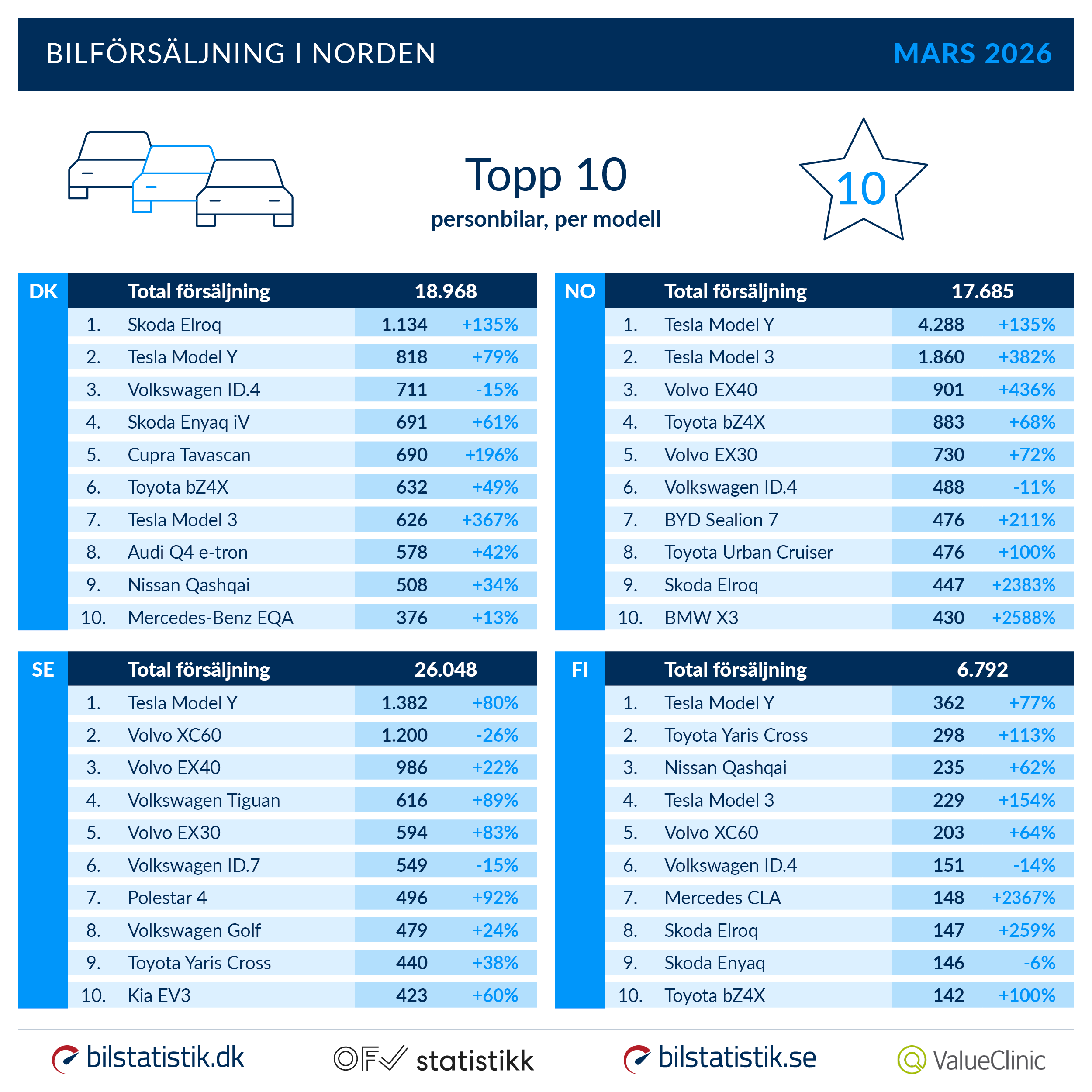
The Tesla Model Y is back as number one in Sweden, Norway and Finland, while in Denmark it has to settle for second place behind the crowd favourite Skoda Elroq. The Tesla Model 3 also appears on the top lists in the Nordic countries, with the exception of Sweden. Tesla's results are particularly remarkable in Norway. There, the Model Y and Model 3 in first and second place together sold more than 1,300 cars more than the other models on the top 10 list combined.
Beyond this, as tradition has it, the four markets go in different directions when it comes to model preferences.
Broad green success in both registrations and vehicle fleet
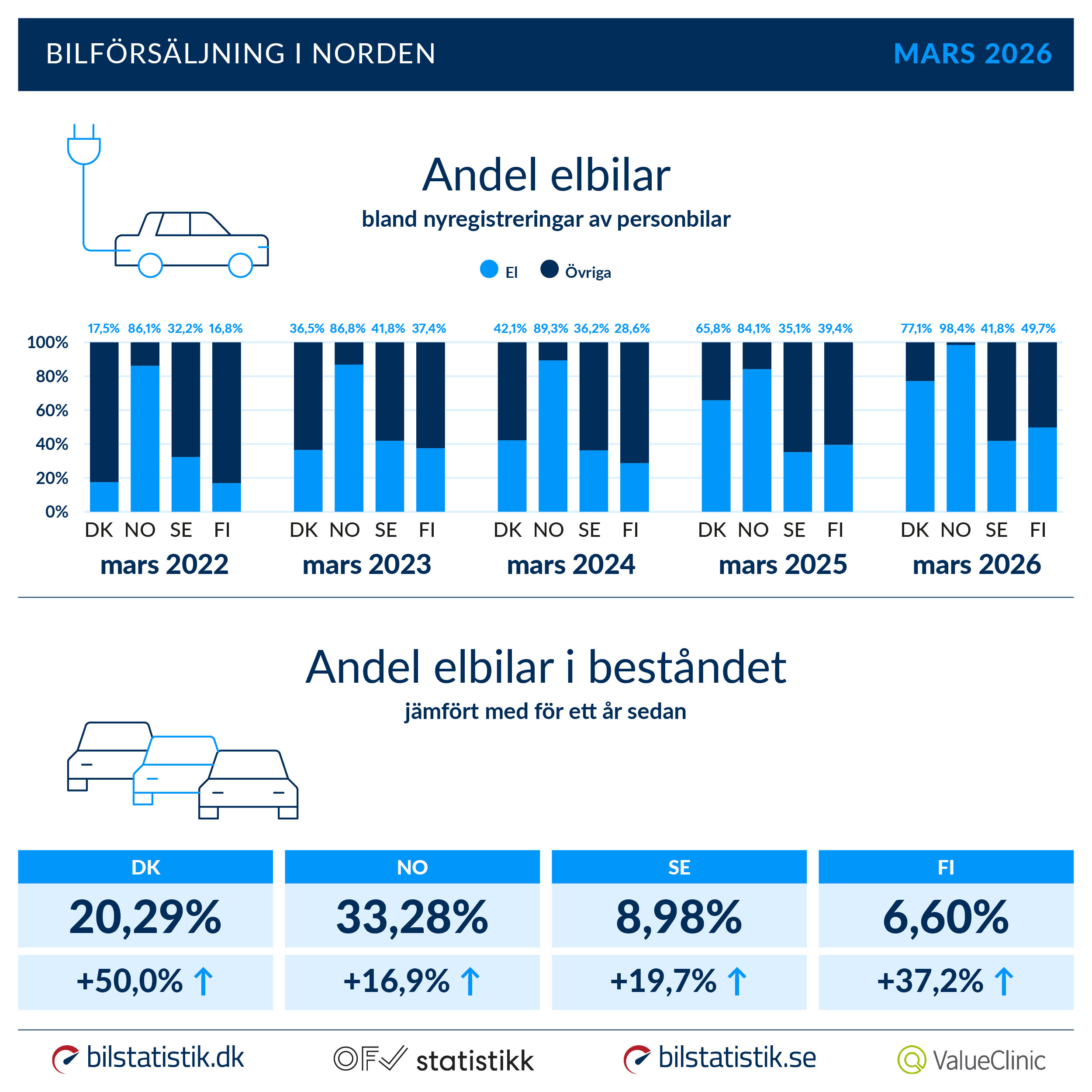
In March too, electric car shares increased in all four markets. Compared with the other Nordic countries, the development in Sweden has been more uneven, and the electric car share has not increased unambiguously month by month. During 2026, however, the development has been steadily positive. In March the Swedish electric car share amounted to 41.8% – an increase of 19% compared with the same month last year, and there may be a clear explanation for this. Andrée Peters, CEO of Bilstatistik.se, says:
“Rising diesel and petrol prices (45% and 26% respectively since February) are helping to get more people to choose electric cars. The same trend is also seen on the used car market. A new state subsidy, which aims to encourage people in rural areas and low-income groups to buy both new and used electric cars, opened for applications on 18 March. There were 3,482 applications in March. It is unclear how many concerned a new and a used electric car respectively, but the subsidy scheme most likely contributed to the new registrations in March and will also do so going forward.”
It is hardly surprising any more that it is Norway that has the highest electric car share in new car sales. In March the share reached 98.4%, which corresponds to as many as 17,406 newly registered electric cars. By comparison, 22 pure petrol cars were registered during the same period. It is the highest electric car share ever in a single month.
In Denmark too the pace has been stepped up. 77.1% of new registrations were electric cars, compared with 65.8% in March last year. Looking solely at new registrations among private customers, the share was an impressive 95% during Q1.
In Finland the development is not quite as strong, but the share is increasing steadily, and in March it amounted to 49.7%, which corresponds to an increase of 26.1% compared with last year.
Although all four countries are moving in a greener direction, it is clear that this is happening at very different paces – and from very different starting points. Jonathan Schacht Halling Nielsen, deputy CEO of Mobility Denmark, says:
“Electric cars are gaining an ever stronger foothold in the Nordics, but the levels differ markedly. Norway and Denmark are still far ahead of Sweden and Finland, and that is a result of the political framework conditions. It underlines how important it is to make it attractive to choose green if the development is to continue.”
The same view is found at OFV in Norway – especially at a time when geopolitical unrest is putting pressure on the business segment. Managing director Geir Inge Stokke says:
“Fuel costs, interest rates and developments in the economy will be of great importance for the choices consumers and businesses make going forward. This applies in particular to the business sector, where many are still dependent on fossil fuels and where long driving distances make cost increases especially noticeable. A predictable policy that supports the transition is therefore crucial.”
Mixed results for heavy vehicles
Despite geopolitical unrest, Q1 ends with positive figures across the board for trucks. With the exception of Norway (-17%), strong March results in Sweden (+37%), Denmark (+28%) and Finland (+11%) helped ensure that the quarter in all those cases ended better than last year. In Denmark, truck registrations landed 15.2% above the Q1 level from last year, in Norway 6.6% above, in Finland 3.8% and in Sweden 3.5% above the 2025 level.
For light trucks the picture is more mixed. Denmark and Sweden end both March and the quarter in positive territory, while Finland and Norway are below last year's level – both in March and for the quarter as a whole. In Sweden, registrations increased in March by 29.3%, which means that the quarter as a whole ends with an increase of 15.3% for light trucks. In Denmark the increase amounts to 16.9% in March and 7.7% for the quarter in total.
At the other end of the scale we find Norway with the biggest decline – 26.7% for the month and 27.2% for the quarter. Sales of light trucks in Finland are also affected. There the decline amounted to 14.4% in March and 15.7% for the quarter.
Just as in Norway, CEO Teemu Rennola from Finland's Value Clinic points to geopolitical unrest as a decisive factor behind the pressured sales of light trucks:
“Developments on the car market at the start of the year point to a gradual return of consumer confidence, but the state of the global economy – such as geopolitical crises and their impact on, for example, oil prices – creates uncertainty about the future. The sharp decline in sales of light commercial vehicles reflects the challenging operating environment of companies: investment decisions are being postponed, and cost pressure affects purchasing decisions more strongly than before.”
Sharing the content of the article
Figures and data from the article may only be shared with a clear reference to the source:
Danish data: Bilstatistik.dk
Swedish data: Bilstatistik.se
Norwegian data: Opplysningsrådet for veitrafikken
Finnish data: Value Clinic (Finnish Transport and Communications Agency Traficom, Transport and Traffic Register)