
2025 turned out to be a decisive year for Nordic car sales, with one record and milestone following another. Sweden, Denmark and Norway all ended in positive territory – for the latter a marked plus – while Finland can once again look back on an exceptionally challenging car year.
2025 is behind us, and it is time for a status report on the Nordic car market.
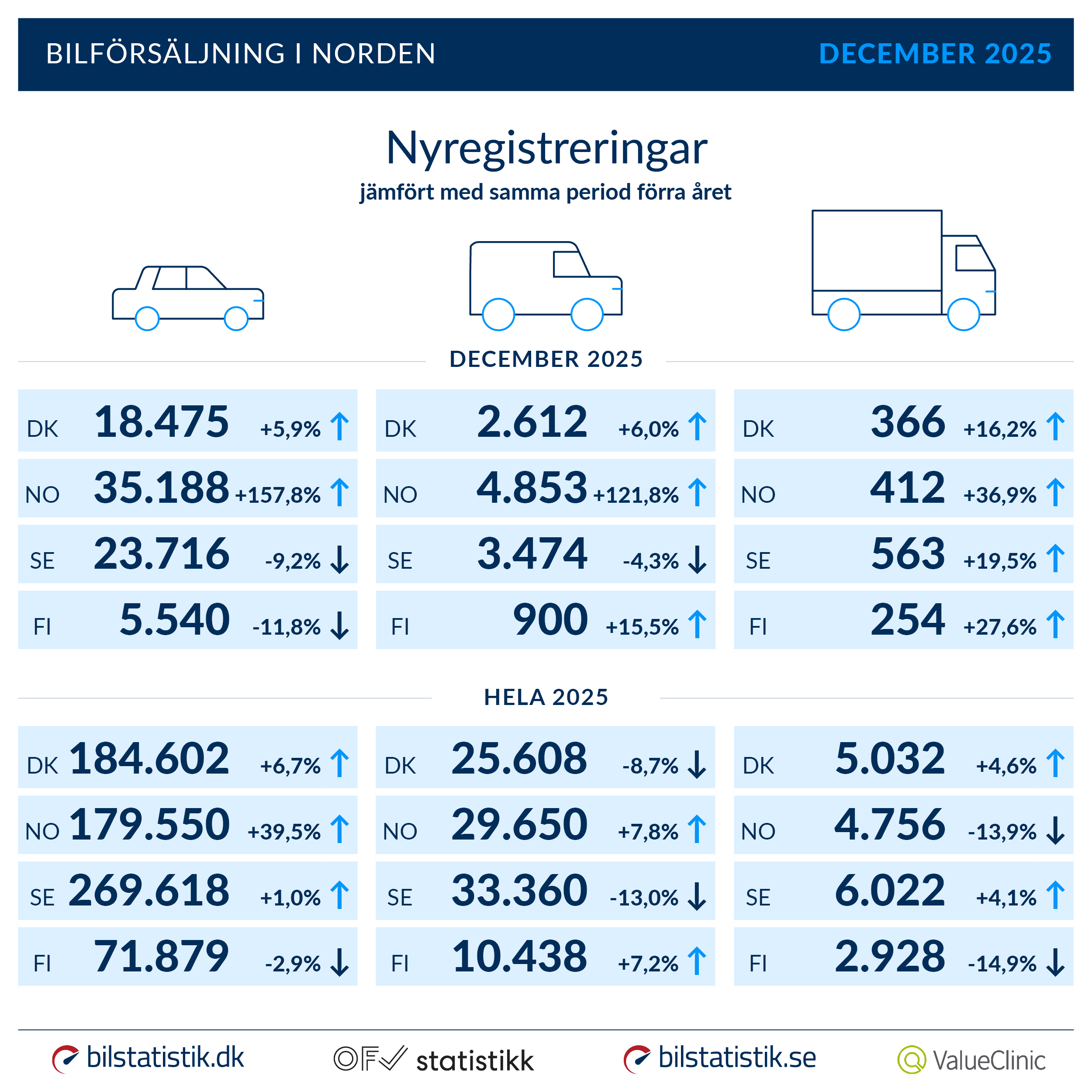
The final month of the year for car registrations was so remarkable that it deserves a quick review first. While Denmark, Sweden and Finland moved within the “normal range”, with passenger car registrations of 5.9%, -9.2% and -11.2% respectively compared with December 2024, the story was somewhat different in Norway.
Already in November we saw record-high levels in Norway, due to the announced changes to the VAT rules from 1 January, but in December passenger car registrations went completely through the roof. 35,188 new registrations, corresponding to 158% above December sales in 2024, deserve a small salute. Never before have so many cars been newly registered in a single calendar month in Norway, and the last two record months also mean that so many cars have never been registered in a calendar year.
Geir Inge Stokke, CEO of the Norwegian Opplysningsrådet for Veitrafikken, says:
“2025 has been a very special car year in Norway. We see the effect of a long-term and determined electric car policy, and how concrete tax decisions have an immediate impact on the market. The final sprint toward the turn of the year has been historically strong, and there is no doubt that the VAT change from 1 January 2026 has contributed to very many choosing to secure a new electric car before the year was out.”
Mixed results for Sweden, Denmark and Finland
The picture was less clear-cut in the rest of the Nordics.
Denmark ended the year with 184,602 newly registered passenger cars and thus lands 6.7% above 2024. You have to go back to 2021 to find levels as high, but it is still some way from pre-pandemic levels if we look only at new registrations and disregard newer imported used cars.
With a total of 269,618 new registrations, Sweden landed 1% below the 2024 level. Setting 2024 aside, we have to go all the way back to 2013 to find lower levels, although a small increase in the private segment could be seen during 2025. Ask Andrée Peters, CEO of Bilstatistik.se, and the Swedish economic situation continues to have a major impact on total car sales:
“The economic situation in Sweden improved somewhat over the past year, and the number of passenger cars registered by private individuals increased by 7% – albeit from the low level of 2024 (34.3%). Registrations by companies (excluding car dealers) went in the opposite direction and fell by 3.7%. Light trucks had their worst registration year since 2020, showing that the downturn continues to affect Swedish businesses. And it is expected to persist for most of 2026.”
In Finland, a total of 71,879 new passenger cars were registered, which means a decline of 2.9% compared with 2024, which in itself was already far from a banner year. The CEO of Finnish Value Clinic does not mince words either when describing the 2025 results:
“2025 was a clear disappointment for new vehicle sales in the Finnish market, especially for passenger cars and trucks. Small bright spots were the clearly increased market share of fully electric passenger cars and the van market as a whole. Next year we forecast moderate growth in the passenger car market, while for the van and truck markets we expect a level in line with last year. Much depends on the economic situation, which has long stood still and which, if it improves, would certainly support new vehicle sales.”
The vehicle fleet became greener across the Nordics in 2025
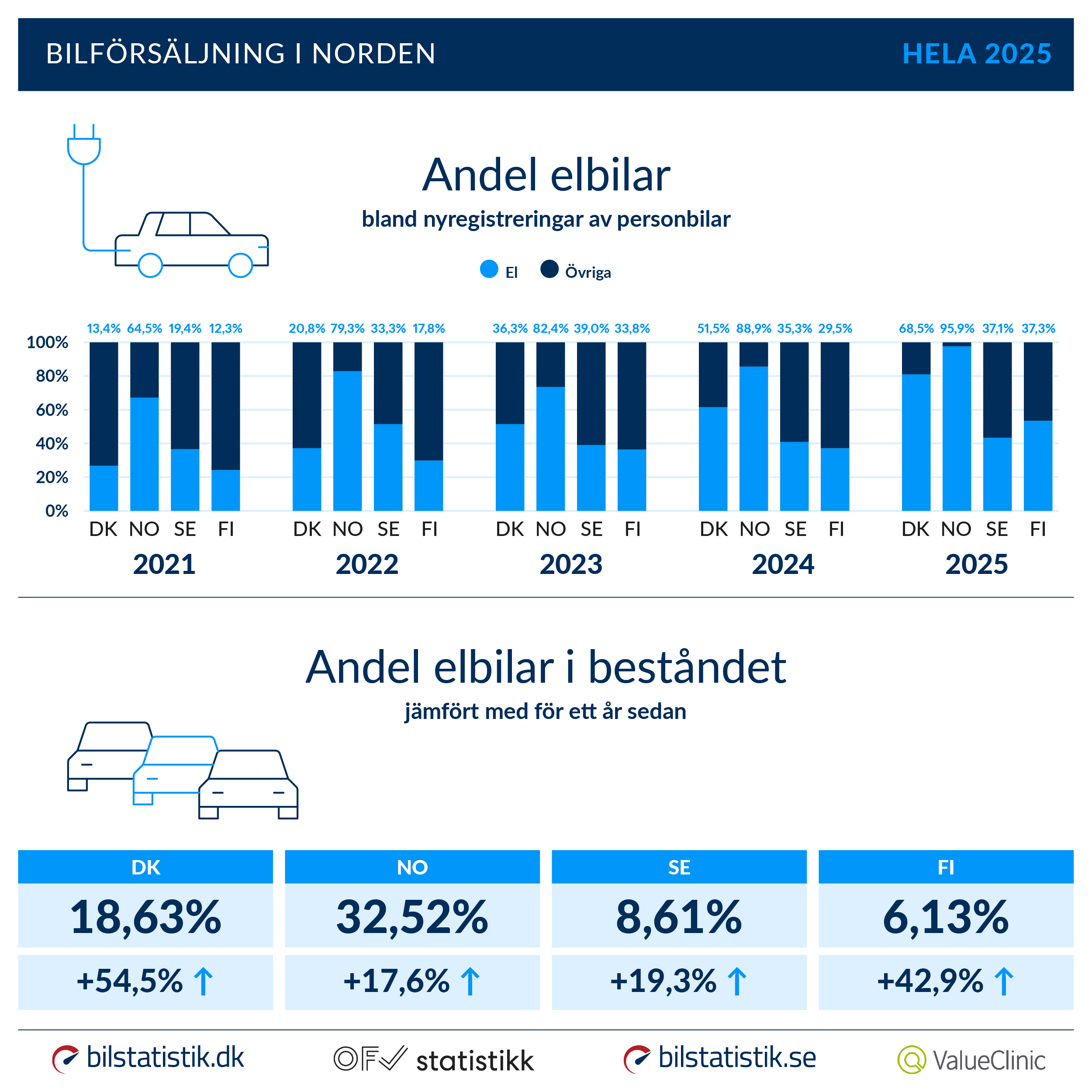
One development that was unambiguous across all four markets in 2025, however, was the direction of electric cars. The share of electric cars among new registrations increased across the board after a 2024 in which the shares fell in both Sweden and Finland. There are, however, big differences in how fast the transition is going. Compared with the full year 2024, the development looks like this:
Denmark: 51.5% to 68.5% (+33%)
Norway: 88.9% to 95.9% (+7.9%)
Sweden: 35.3% to 37.1% (+5.1%)
Finland: 29.5% to 37.3% (+26.4%)
Once again it is Norway that stands out most, with an almost fully electrified new-car picture, but Denmark follows strongly with impressive growth figures. Mads Rørvig, CEO of Mobility Denmark, underlines that this picture is precisely the result of political priorities:
“The experience from the Nordics shows that the development of electric cars depends to a large extent on the framework conditions. There is a big difference in how much electric cars have been prioritised politically between the Nordic countries, which is clearly illustrated by the 2025 results. In Denmark, good conditions have been created for continued development through the finance agreement, which retains the reduced registration tax on electric cars in 2026.”
The four electric car fleets are also undergoing major change. In Denmark in particular, the drivetrain distribution of the fleet is developing quickly and unambiguously. While more and more electric cars are added, both through new registrations and record-high used imports, Danes are seeing an ever-increasing number of ICE cars scrapped or exported. In this way the share of electric cars in the fleet has grown by a full 54.5% in a single year, which means that Danes passed 500,000 electric cars in the fleet earlier in the year.
Clear winners at model level – but we do not agree on which
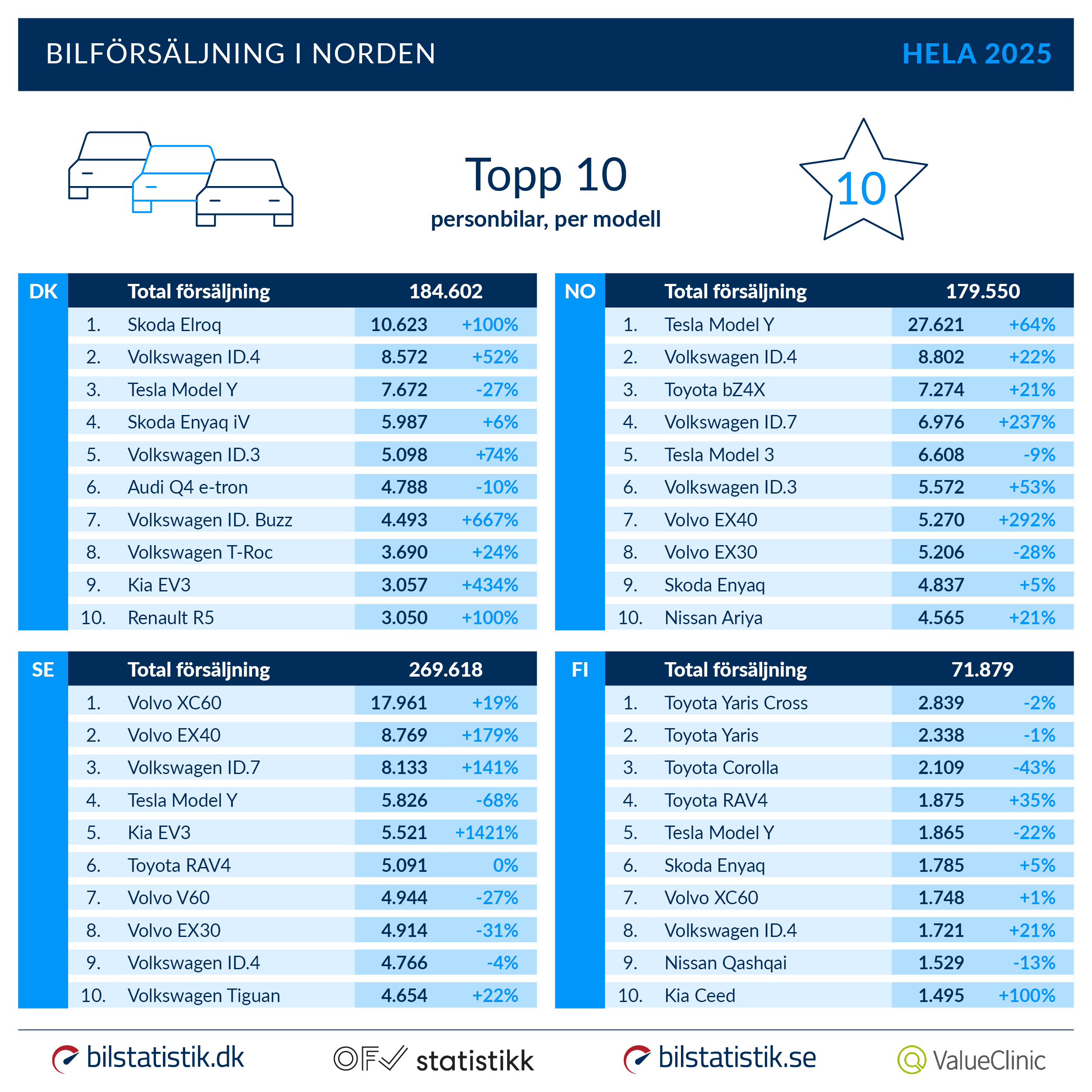
One thing we rarely agree on in the Nordics is which models we prefer, and the 2025 top lists bear witness to that too. The only models that made the top 10 lists in all four countries were the Volkswagen ID.4 and the Tesla Model Y.
In Norway and Sweden in particular, however, there were completely dominant winners in 2025. In Norway, the Tesla Model Y swept aside all competition with 27,621 new registrations. That is more than three times as many cars as the runner-up, the Volkswagen ID.4. In Sweden it was the Volvo XC60 that, with 17,961 new registrations, beat the runner-up, the Volvo EX40, by more than 9,000 units sold. Although first place in Finland is not as convincing as in Norway and Sweden, there is still no doubt where the preferences lie. The top four places on the list are held by Toyota.
A mixed year for trucks and light trucks
2025 turned out to be a mixed experience when we turn our eyes to the heavy vehicles, even though both light trucks and trucks ended the year strongly in December.
For light trucks, it is once again Norway that takes the most headline-worthy results. After a December in which the new-registration level was a full 122% above 2024, it ends the year with a plus for light trucks of 7.8%. Next come the Finns, who with +15.5% light truck registrations in December land at +7.2% for the year. In Denmark and Sweden, the year for light trucks closes at -8.7% and -13% respectively.
Trucks had a strong December across the board. The positive development ranged from +16.2% in Denmark, +19.5% in Sweden and +27.6% in Finland up to +36.9% in Norway.
For the full year, this means that both Denmark and Sweden end with a modest plus of 4.6% and 4.1% respectively, while Norway and Finland have to settle for declines of 13.9% and 14.9% respectively.
Sharing the content of the article
Figures and data from the article may only be shared with a clear reference to the source:
Danish data: Bilstatistik.dk
Swedish data: Bilstatistik.se
Norwegian data: Opplysningsrådet for veitrafikken
Finnish data: Value Clinic (Finnish Transport and Communications Agency Traficom, Transport and Traffic Register)