September was another record month for Nordic car sales, with three out of four countries reaching their highest ever electric car shares. All markets also ended the month with solid growth in passenger car sales, with one model playing a particularly important role.
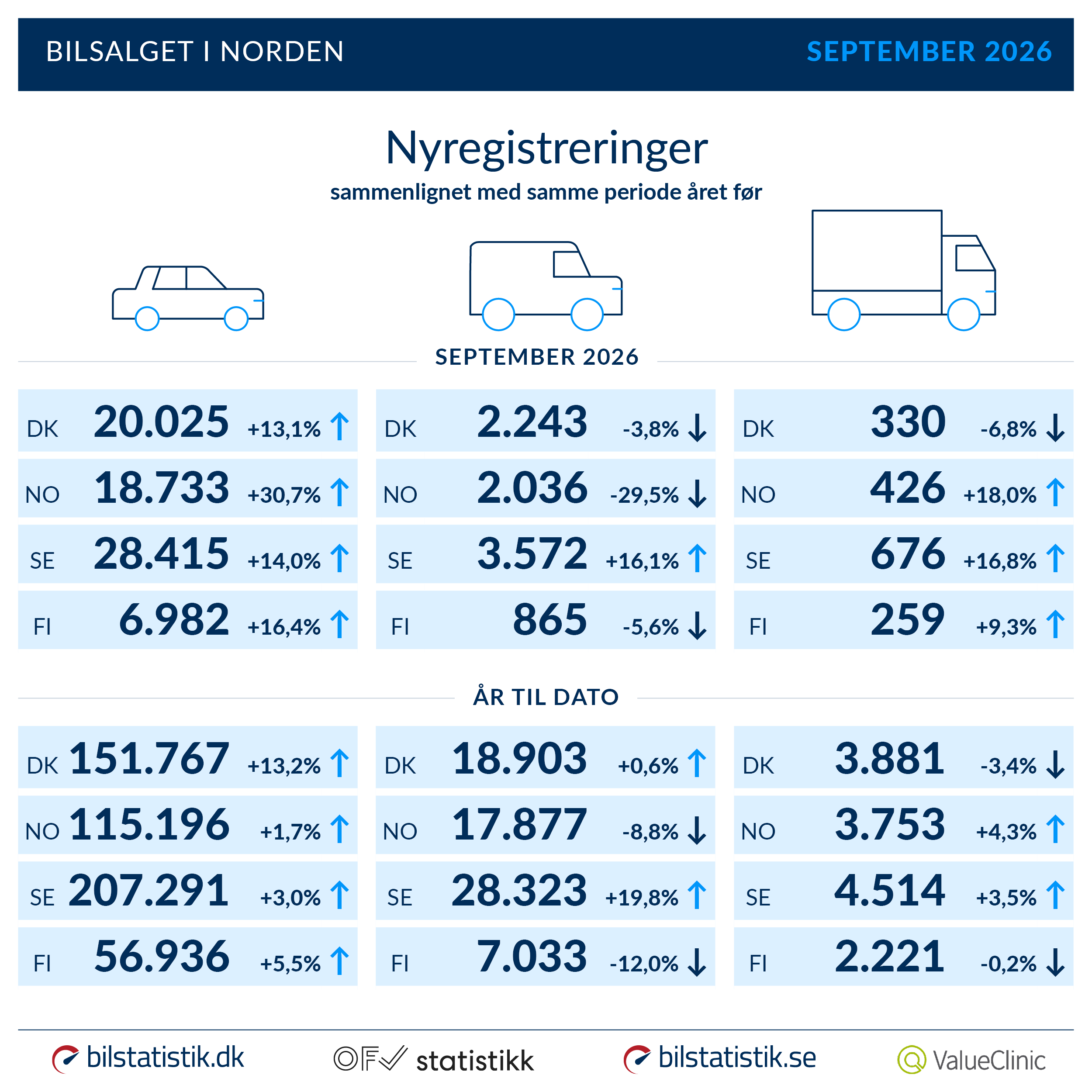
The ninth month of the year was a strong one for Nordic passenger car sales. Growth was strongest in Norway, where 18,733 new registrations marked a 30.7% increase compared with September last year. The other three markets also ended September on a positive note: Finland was up 16.4% with 6,982 registrations, Sweden rose 14% to 28,415, and Denmark closed the month 13.1% higher, with 20,025 newly registered passenger cars.
September’s strong performance also means that all four markets are now up for the year. Growth has been greatest in Denmark, at 13.2%, followed by Finland at 5.5%, Sweden at 3% and Norway at 1.7%.
Record after record for electric cars
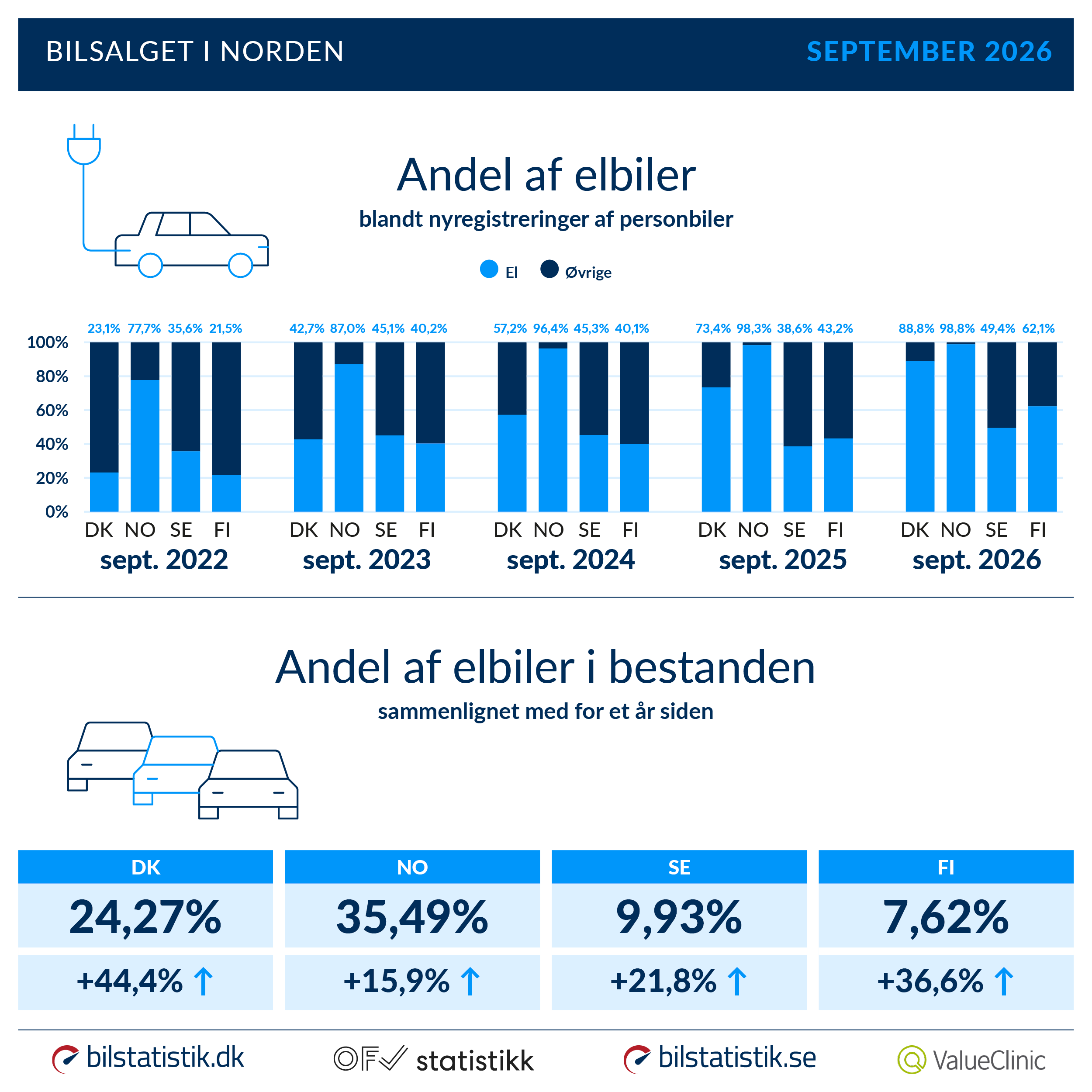
Electric cars also had an exceptionally strong September. Norway, Denmark and Finland all reached their highest levels to date, while Sweden is also approaching the record set in December 2022.
Norway reinforced its electric car dominance, with battery electric vehicles accounting for 98.8% of new registrations, surpassing its previous record of 98.7%. Denmark also set a new market share record at 88.8%. This trend may continue towards the end of the year, as tax increases on more expensive electric cars are scheduled to take effect. Finnish electric car sales set a record for the third consecutive month, with the share now at 62.1%.
Although Sweden’s electric car share is also rising, at 49.1% it remains just short of the current record of 51%. Even so, electric cars clearly have a major impact on the overall Swedish market. Andrée Peters, CEO of Bilstatistik.se, explains:
“Electric cars are driving passenger car registrations in Sweden, and numbers have risen by as much as 46% compared with the same period last year. Private car buyers are largely behind this development, although the market level is probably also affected by the fact that government subsidies for petrol and diesel will soon end.”
Demand for electric cars continues to shape the Nordic vehicle fleets. In Denmark, almost one in four passenger cars on the road is now electric, an increase of 44% over the past year. Norway’s electric car share of the fleet has reached 35%, while Sweden is just short of the 10% mark. Finland is also seeing momentum, with growth of 36.6% over the past year, but from a low starting point its electric car share stood at 7.6% at the end of September.
Mobility Denmark is surprised that the announced tax increases on electric cars appear set to take effect after the turn of the year:
“The car market is moving at full speed, and electric cars have become the Danes’ preferred choice. This is highly significant for the green transition of the vehicle fleet and contributes substantially to Denmark reaching its climate targets. It is therefore striking that a government calling itself the greenest ever is choosing to increase the tax on electric cars from the New Year. It is hard to understand why Danes’ support for electric cars should be met with a higher tax bill,” says Mads Rørvig, CEO of Mobility Denmark.
Tesla is firmly back on top
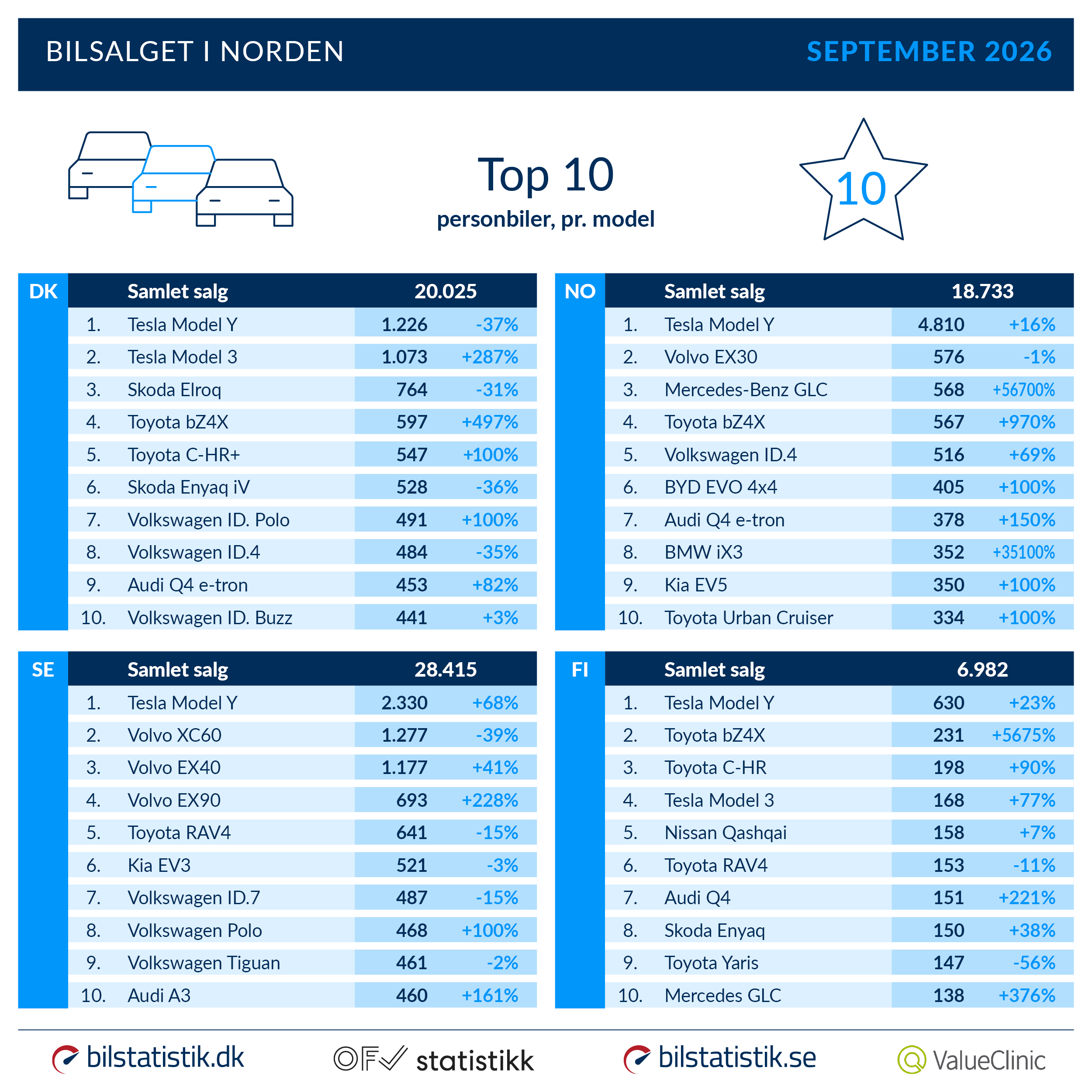
After a period of mixed results, Tesla is firmly back at the top of the Nordic top-10 lists. The Model Y takes first place in all four markets. The results are particularly notable in Finland and especially Norway. In Finland, the Model Y sold almost three times as many units as the second-placed Toyota bZ4X; in Norway, eight times as many Model Ys were registered as Volvo EX30s in second place. That is an impressive result by any measure.
Vans and trucks remain broadly unchanged
Results for vans were less impressive, largely continuing the pattern seen so far this year. Sweden is the strongest market both year to date and for September. With 3,572 new registrations in September, Sweden recorded growth of 16.1% and is now 19.8% above its 2025 level year to date.
In Norway, van registrations fell 29.5% in September, leaving the market 8.8% below last year overall. Denmark’s modest 3.8% decline in September leaves it 0.6% up year to date. Finnish registrations fell 5.6% in the past month, putting Finland 12% below its 2025 year-to-date result.
For trucks, this month’s results put all four markets at roughly the same level as the corresponding period last year. Sweden and Norway are slightly above the line, with growth of 3.5% and 4.3%, while Denmark and Finland are down 3.4% and 0.2%, respectively.
In Finland, there are several possible explanations for why the van market in particular is struggling to follow the positive growth seen in the passenger car market in recent months:
“Reports of economic growth have yet to reach the van market, and the decline in financed purchases and leasing agreements may also reflect companies’ difficulties in obtaining financing. Geopolitical tensions and interest rates continue to cloud the outlook,” says Teemu Rennola, CEO of Finland’s Value Clinic.
Sharing data
Figures and data from this article may only be shared with the following source references:
Danish data: Bilstatistik.dk
Swedish data: Bilstatistik.se
Norwegian data: Opplysningsrådet for veitrafikken (OFV)
Finnish data: Value Clinic (Finnish Transport and Communications Agency Traficom, Transport Register)