Denmark was the only market to end April with a plus for passenger cars. Light trucks, on the other hand, had a strong month in the Nordics – and the same can be said of the electric car shares.
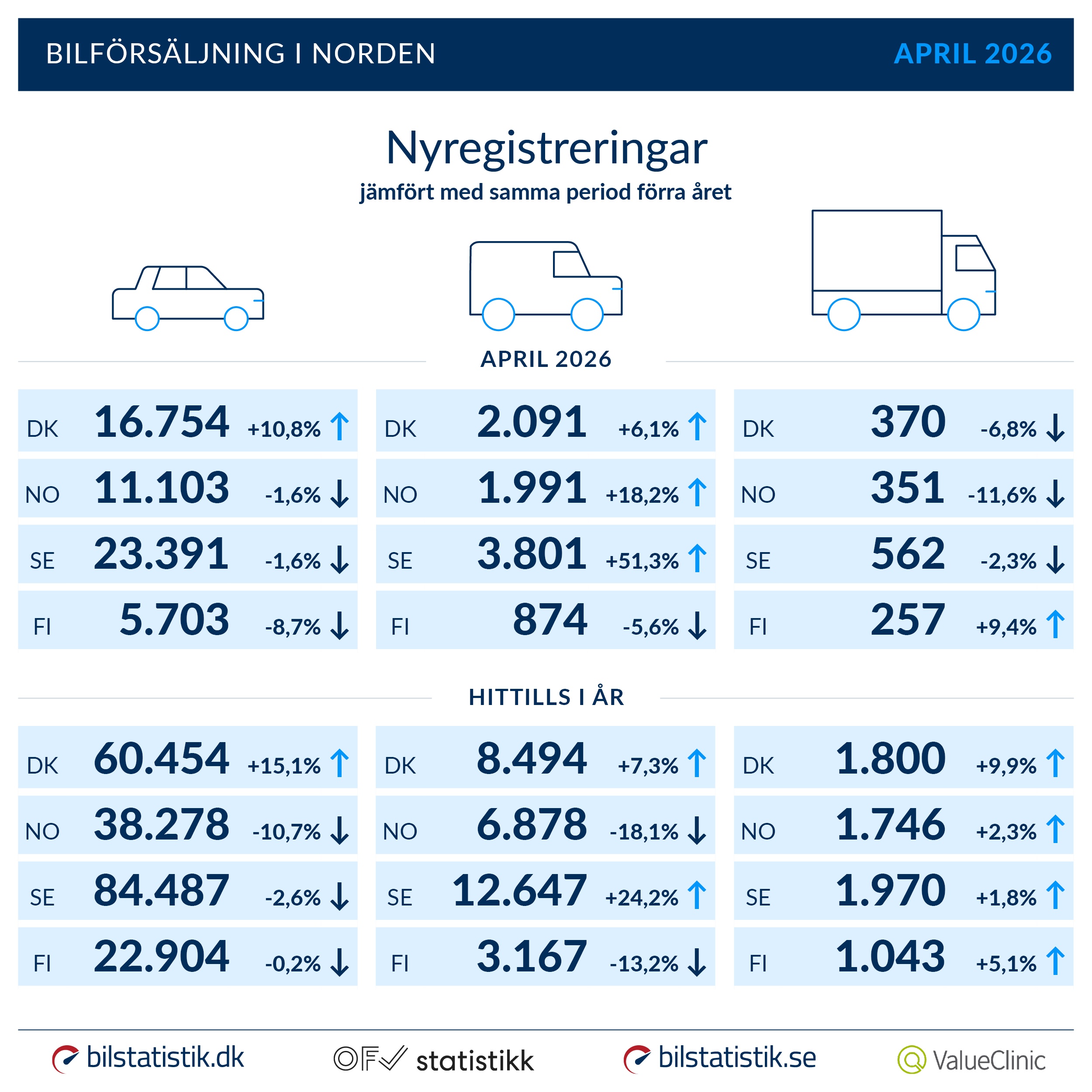
With 16,754 newly registered passenger cars and an increase of 10.8 percent, the Danes can look back on yet another strong registration month. In Norway and Sweden, 11,103 and 23,391 new registrations were recorded respectively, which meant a modest decline of 1.6 percent compared with April last year. In Finland, a couple of stronger months have been followed by yet another setback. With 5,703 newly registered passenger cars, the month ended at minus 8.7 percent.
Teemu Rennola, CEO of Finland's Value Clinic, comments:
“After a relatively positive first quarter, we are once again in a declining registration market. The outlook for the rest of the year remains weak, and consumer confidence is still at very low levels – close to historic lows. A more positive development requires not only a change in the geopolitical situation, but also a clear turnaround in the Finnish economy or at least a broader awakening of consumer optimism.”
New records for electric car sales
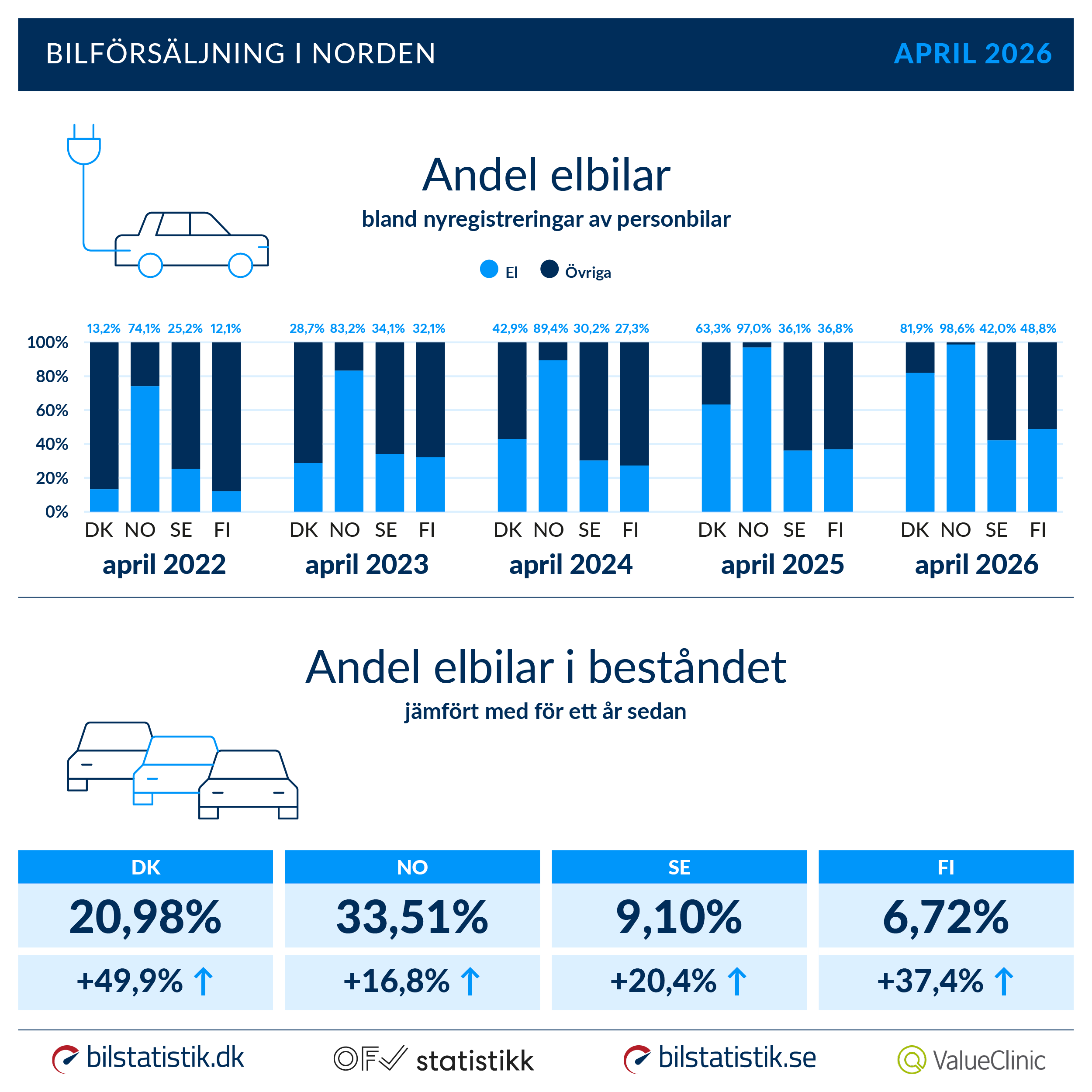
Once again, the Nordics as a combined market can look back on a month of rising electric car shares. In Norway, a share record was set for the second month in a row, this time with as much as 98.6 percent of new car sales. Of over 11,000 new registrations, only 31 were petrol cars.
“In April we set a new electric monthly record for new registrations of passenger cars for the second month in a row. When the electric car share for passenger cars is above 95 percent in all of the country's counties, there is no longer any doubt that Norwegians generally choose electric drive when buying a new car. It is about price, technology and availability alike – and that is good news for both the climate and road safety,” says Geir Inge Stokke, director of the Opplysningsrådet for veitrafikken.
Denmark continues at a strong growth pace with a total of 81.9 percent electric cars. That is an increase of 29.4 percent from an already high level. Looking solely at electric car sales to private individuals, Denmark is approaching Norwegian levels with as much as 96.3 percent. That is the highest share Denmark has reached so far. The high pace is also noticeable in the powertrain distribution in the Danish vehicle fleet, where the electric car share has increased by 50 percent in just one year. Thus 21 percent of all registered cars on Danish roads are electric cars. In Norway the share is just over 33 percent.
Mads Rørvig, CEO of Mobility Denmark, calls for political action if the positive Danish development is to be able to continue:
“The tax benefits for electric cars are being phased out from 2027, which will make them considerably more expensive. This limits ordinary Danes' opportunity to choose an electric car and thus makes it difficult to maintain the current green development in the industry, which contributes to less air pollution and reduced carbon dioxide emissions. During the election campaign, several parties expressed support for electrification and a willingness to make Denmark more independent of fossil fuels. It is an obvious opportunity to achieve that development through a new model for car taxation, where the registration fee on electric cars is abolished.”
In Sweden and Finland we still do not see the same high levels, but both markets show clear growth in the electric car segment. In Finland, April ended with an electric car share of 48.8 percent, corresponding to an increase of 32.6 percent compared with last year. Sweden landed at a share of 42 percent, corresponding to an increase of 16.3 percent. The relatively moderate Swedish increase gains an additional dimension because part of the increase is assumed to be connected to the new state electric car subsidy, which aims to encourage electric car purchases in rural areas and among low-income groups. Andrée Peters from Bilstatistik.se says that 2,500 applications under the new subsidy scheme were approved during April, but that it is unclear how they are distributed between new and used electric cars.
Strong month for light trucks
When it comes to light trucks, it was without doubt Sweden that fared strongest through April. With 3,801 new units, the market landed at plus 51.3 percent, which must be regarded as a very strong result. Norway also had a good month for light trucks with an increase of 18.2 percent, while Denmark had a more modest rise of 6.1 percent. Finland ended the month with a decline of 5.6 percent.
Apart from the electric car shares, trucks were the Finnish bright spot in April, with a rise of 9.4 percent. The other three markets, on the other hand, had to note a decline in truck registrations. The decline was biggest in Norway with minus 11.6 percent, followed by Denmark with minus 6.8 percent and Sweden with minus 2.3 percent.
Sharing the content of the article
Figures and data from the article may only be shared with a clear reference to the source:
Danish data: Bilstatistik.dk
Swedish data: Bilstatistik.se
Norwegian data: Opplysningsrådet for veitrafikken
Finnish data: Value Clinic (Finnish Transport and Communications Agency Traficom, Transport and Traffic Register)