
With few exceptions, the Nordic car market had a relatively calm February, where the most prominent headlines concern rising electric car shares across the board.
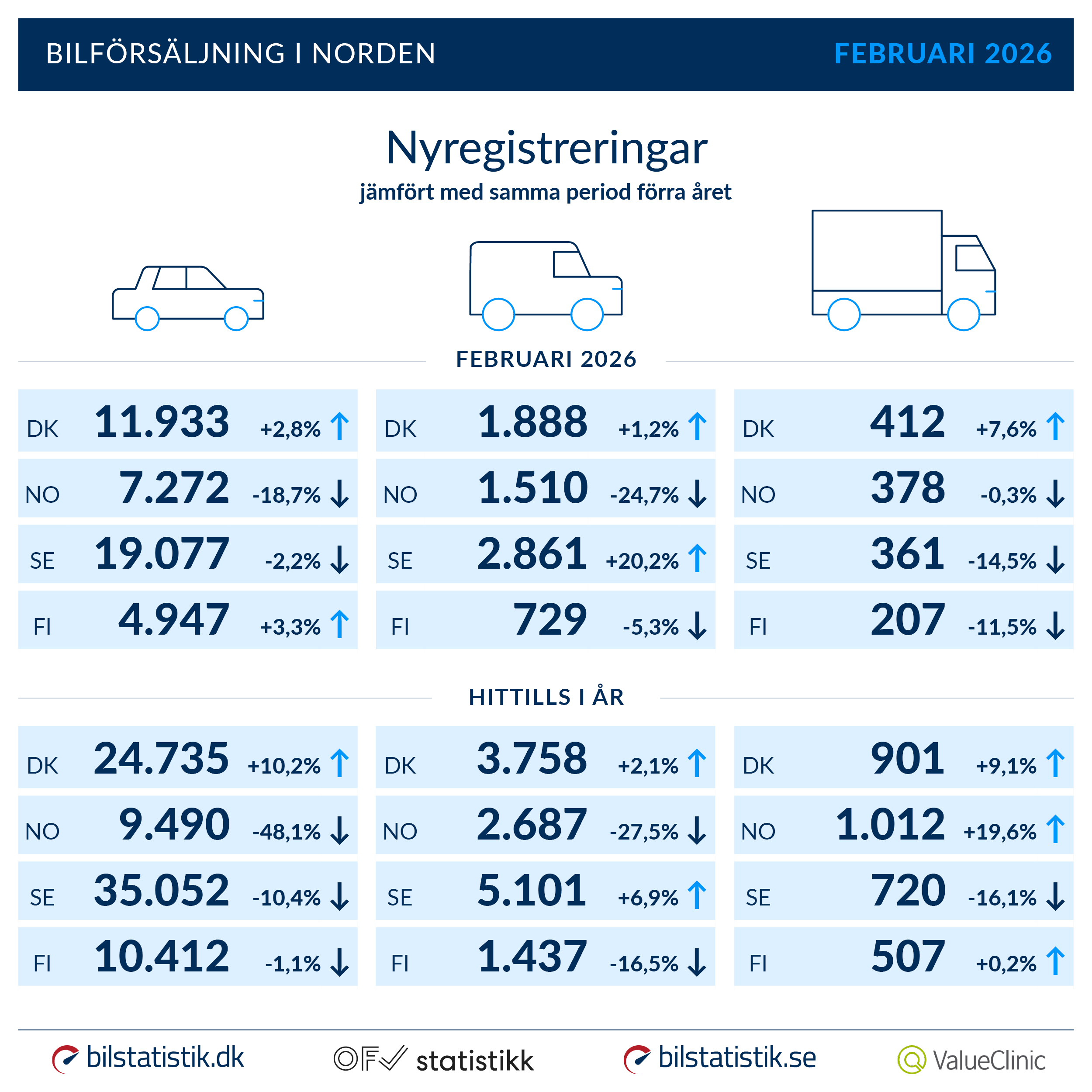
If we disregard Norway, passenger car registrations landed at roughly the same level in February as at the same time last year. In Denmark and Finland the month ended at +2.8 and +3.3% respectively. In Finland in particular there is reason to be pleased to see green figures on that line again, and Teemu Rennola, managing director of Finland's Value Clinic, also looks with cautious optimism at the rest of the quarter:
“February's registrations reflect a market showing cautious signs of improvement. The increase of 3.3 percent in passenger car registrations — and especially the fact that growth had already reached as much as 17.6 percent by the 27th day of the month — suggests that demand has not disappeared, but rather swings sensitively with the calendar and the economic situation. Even though the start of the year as a whole is still 1.1 percent below last year, the current development gives a realistic hope that the first quarter can end positively.”
Decline in Sweden and Norway – but there are good explanations
In Sweden and Norway, on the other hand, red figures were recorded in February. The Norwegian registration level landed 18.7% below the result in February 2025. The level has thus been raised from the record-low level in January, but the bulk purchases seen before the VAT changes at the turn of the year still seem to shape the willingness to register new vehicles. In Sweden, which had to end February with a minus of 2.2%, the end of February — and thus the combined Swedish new registration figures for the month — was affected by grit in the machinery of the Swedish Transport Agency.
Andrée Peters, director of Bilstatistik.se, explains:
“The month's registration figures have been affected by the disruptions the Transport Agency experienced at the end of the month, when registrations and changes of ownership could not be carried out in Sweden for a couple of days. There is then reason to assume that last year's level could otherwise have been matched in February. At the same time we see that the number of private individuals taking delivery of a new car continues to increase while the number of cars delivered to companies continues to decrease.”
Mixed results so far this year
So far this year, only the Danish passenger car market is in positive territory, more precisely 10.2% above last year's level. Finland, which was already at a low registration level, is 1.1% below the level at the same time last year at the end of February. Sweden has to note a decline in registrations of 10.4%, while the Norwegians, with a fall of 48.1%, pay the price for the record level last year. In this context, the managing director of Norway's Opplysningsrådet for Veitrafikken, Geir Inge Stokke, says:
“We are now seeing signs that the Norwegian market is moving back towards a more normal level of activity after the shifts around the turn of the year as a result of the VAT changes. February is still below last year's level, but developments during the month suggest that the market is gradually recovering.”
Stable green development – but it is fastest in Denmark
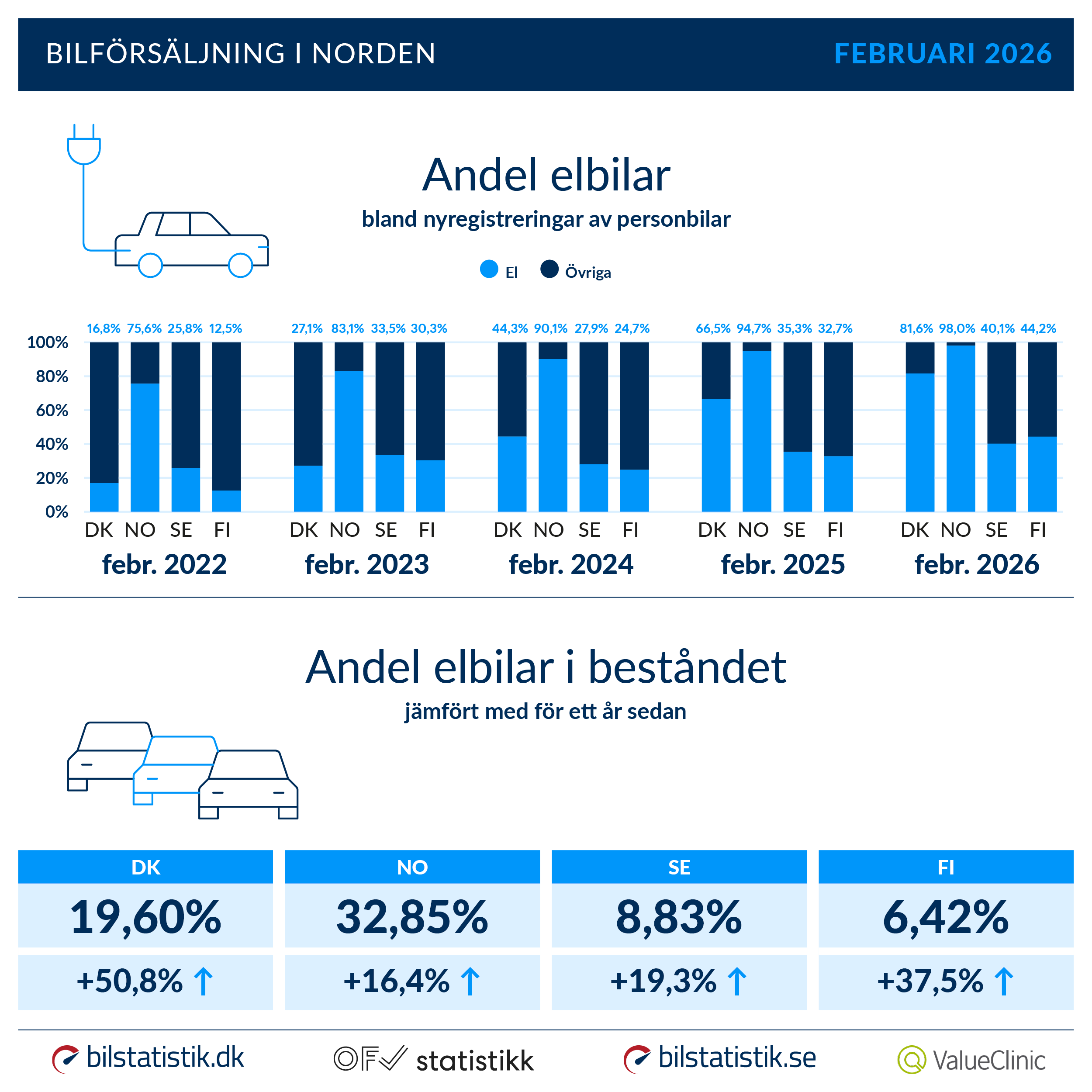
In February too we saw rising electric car shares in all four markets. It will be a while before anyone can come close to Norway's superb electric car share, which in February landed at 98%. That said, things are really picking up speed in Denmark. In total, Danish new registrations reached an electric car share of 81.6%, but private users alone reached a share of as much as 94.4%. In both Sweden and Finland, too, the development has been going in a greener direction several months in a row. In Sweden the share landed at 40.1% of new registrations and in Finland at 44.2%.
Although replacing the large fossil-fuelled car fleet in the Nordics will of course take time, the high electric car shares in new registrations can naturally also be read in the fleet development. In Norway almost every third passenger car in the fleet is an electric car, while the Finns at the other end of the scale have an electric fleet of 6.4%. But development is relatively fast. In just one year the fleet has grown by 50.8% in Denmark, 37.5% in Finland, 19.3% in Sweden and 16.4% in Norway.
Brand and model loyalty is limited
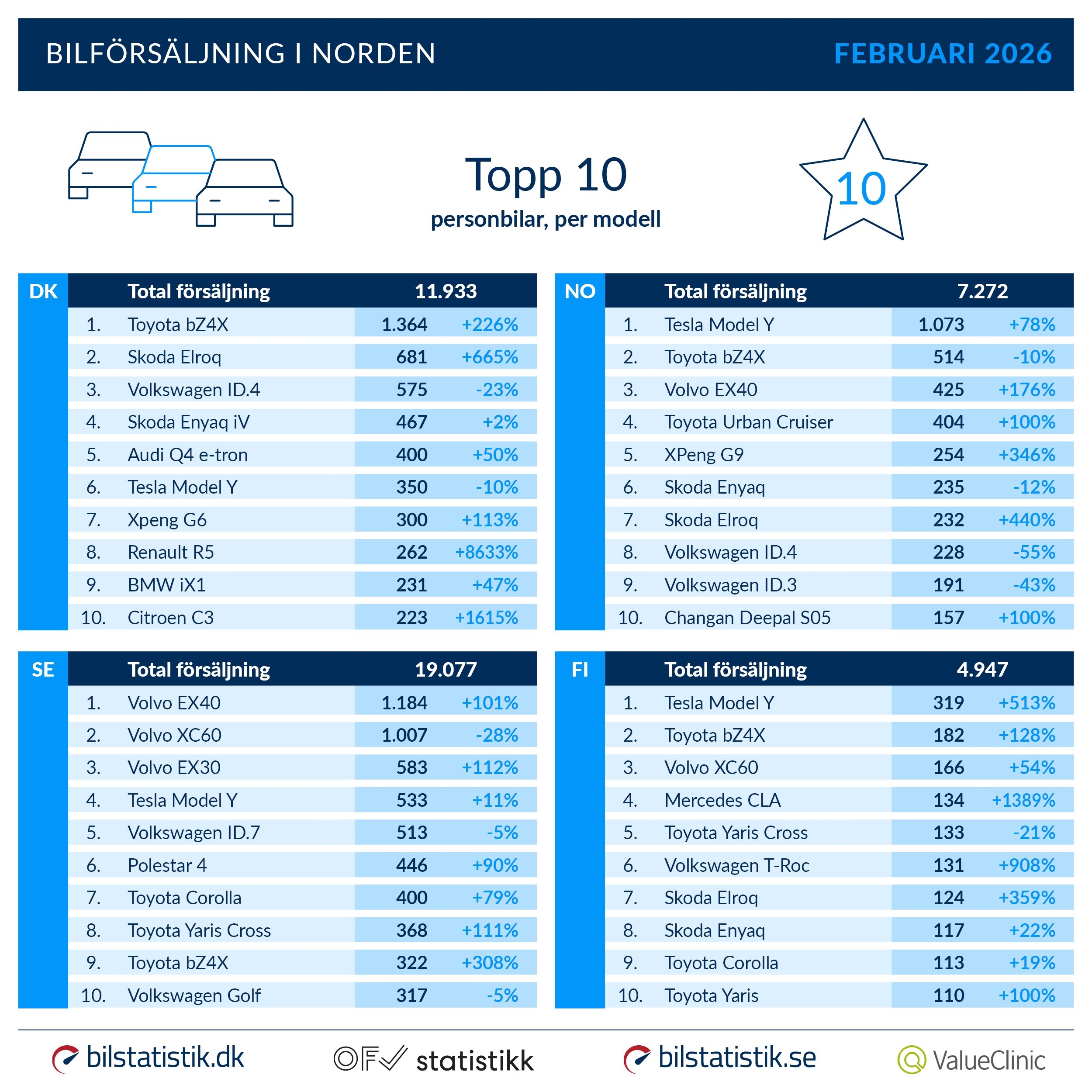
The top lists all have in common that they are dominated by electric cars. Two models recur on all four countries' lists, and they are Toyota's bZ4X and Tesla's Model Y. As usual Volvo is far ahead in Sweden, while the other three countries' lists are to a greater extent characterised by variety and attractive campaigns. In Denmark in particular the top list was shaken up in February, with as many as nine different brands represented. Among other things there was a reunion with Citroën, which with its new electric C3 only just makes it into tenth place.
Light trucks and trucks have had a mixed start
Registrations of the heavier vehicles have had a rather mixed start to the year. As for trucks, only the Danish market showed growth in February. It was +7.6%, corresponding to a total of 412 new registrations. Norway landed a hair's breadth from the February 2025 results, at -0.3% and a total of 378 new registrations. With 361 newly registered trucks, the Swedish level fell by 14.5%, followed by Finland, which with 207 new registrations is 11.5% below the level in February last year.
The results for light trucks are just as mixed as for trucks, albeit with somewhat bigger swings. Sweden did clearly best, ending February with a plus of 20.2% on 2,861 newly registered light trucks — and that result must, as mentioned, be seen in the light of the problems at the Transport Agency, which made registrations impossible during the last days of the month. In Denmark the month ended 1.2% above last year's February level, Finland 5.3% below, and in Norway the row of red figures was completed with a decline of 24.7% for light trucks.
Sharing the content of the article
Figures and data from the article may only be shared with a clear reference to the source:
Danish data: Bilstatistik.dk
Swedish data: Bilstatistik.se
Norwegian data: Opplysningsrådet for veitrafikken
Finnish data: Value Clinic (Finnish Transport and Communications Agency Traficom, Transport and Traffic Register)