The Nordic car market has had a somewhat shaky start to 2026. Only Denmark made it through January with green figures, while Finland, Sweden and especially Norway were hit hard. At the same time the share of electric car registrations increased in all markets but one – the Norwegian.
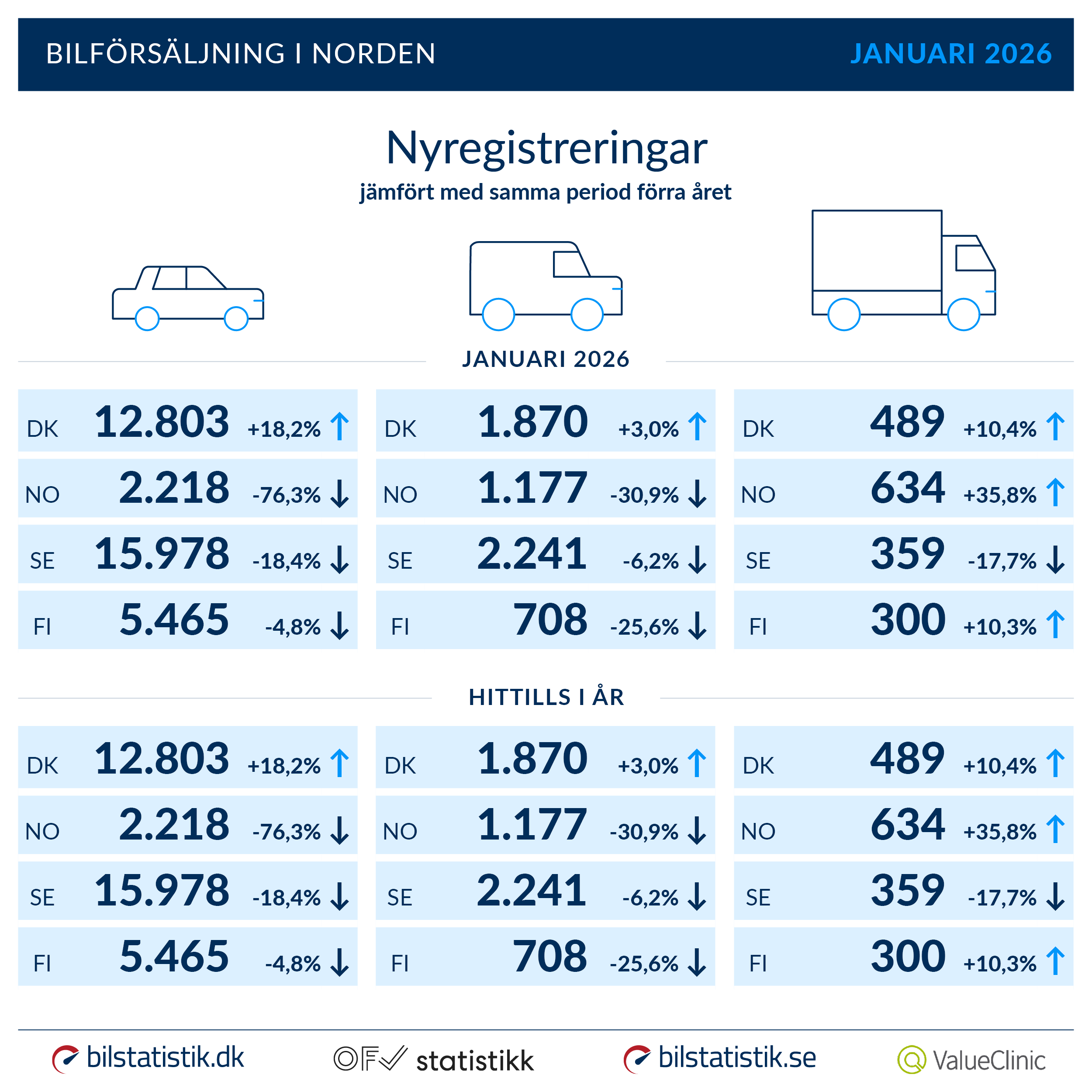
Now the first month of 2026 is done, and for some markets one probably wished January was one of those presents that can be exchanged. Only Denmark can look back on a registration month that ended better than January last year. With 12,803 newly registered passenger cars, Denmark lands at +18.2% compared with last year. In Sweden and Finland, on the other hand, declines of 18.4 and 4.8% respectively have to be noted.
In Sweden the swings are seen to be largely due to individual factors, while it is also clear that it is mainly companies that are pulling the figures down. Andrée Peters, director at Bilstatistik.se, says:
“Both Volvo and VW start the year weakly with almost 1,800 fewer passenger car registrations than last year. This corresponds to about half of the decline we see on the market in January. The other half can largely be explained by the abnormally large number of ethanol cars registered in January 2025, which now creates a skewed comparison figure for the month. The private leasing market is increasing sharply by 47%. The leasing market for company cars is decreasing by 6%. A strongly contributing cause is Volvo, which loses as much as 46% of the number of cars leased to companies. Challenges with delivery times and prospective buyers waiting for the EX60 surely matter.”
And then we have the Norwegians, who after a record finish to 2025 woke up to the expected January hangover and only 2,218 newly registered passenger cars. That is 76% below the 2025 level. Geir Inge Stokke, director at Norway's Opplysningsrådet for Veitrafikken, takes the figures with elevated calm:
“It was a lukewarm start to new car registrations in Norway in 2026. The tax and fee changes just before the turn of the year created artificial sales peaks and a subsequent abrupt fall. We saw something similar after the VAT change in 2023. The January figures are therefore not a sign that demand has stopped, but a result of the extraordinary final sprint before New Year. We expect registrations to pick up again as the market stabilises.”
The electric car share is rising everywhere – just not in Norway
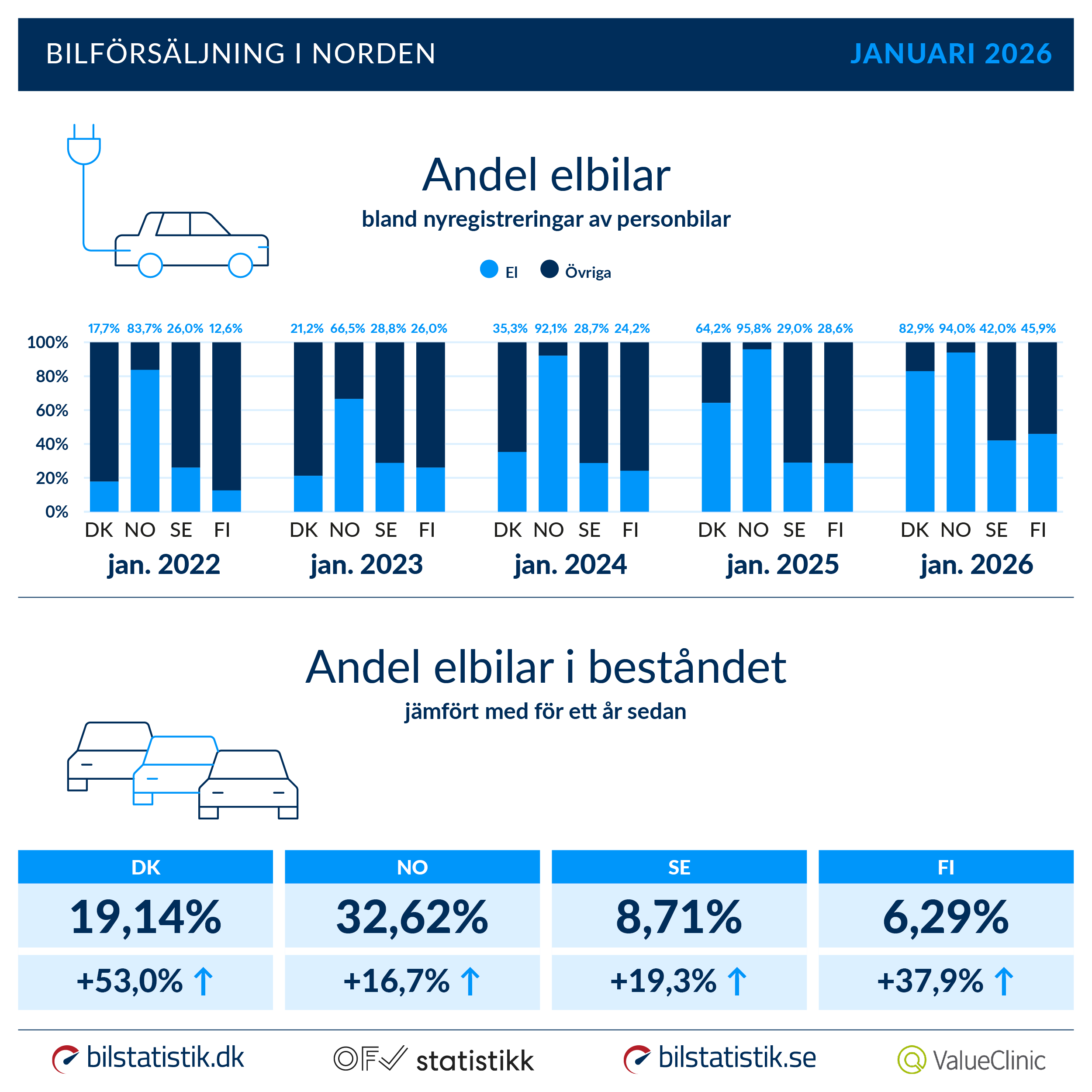
In addition to the sharp Norwegian registration drops, Norway also takes home another clear (and rare!) headline in January. The share of electric cars among new registrations has namely fallen slightly, to 94%, compared with January 2025 when the electric car share stood at as much as 95.8%.
On the other hand, the January results for the remaining three markets look really uplifting. Denmark is now up at an electric car share of 83% of new registrations – an increase of 29.1% in just one year. Finland, which has so far calmly and steadily built up its green vehicle fleet, takes a big step forward with an increase of 60.5%, and lands at a total electric car share of 46% in January. In Sweden, where there has long been a struggle with stagnating electric car shares, there is also a nice leap in January – mainly driven by private leasing. An increase of just under 45% since January 2025 leaves the Swedes with a combined electric car share of new registrations of 42%.
At Mobility Denmark they view that picture positively, but also stress that continued development requires the right incentives:
“Electric cars are taking up more and more space in Scandinavia, and the green transition is well and truly under way in all countries. Development has been at a particularly high pace in Denmark in recent years, and we estimate that we are soon approaching Norwegian levels. Continued success does, however, require good conditions, and it is therefore absolutely crucial that the reduced registration fee for electric cars has been retained in 2026,” says Mads Rørvig, CEO of Mobility Denmark.
The development is also starting to leave its mark on the Nordic fleets.
In Denmark a milestone was passed in January when electric cars overtook diesel cars in the vehicle fleet, and in total Denmark is now at 19% electric cars – beaten only by Norway's 33%. In Sweden it is approaching 9% and in Finland it has just passed 6%.
Although the situation for car sales in Finland can hardly be called brilliant, Teemu Rennola, CEO of Finland's Value Clinic, views the progress of electric cars positively:
“Even though January was still subdued, the sharp increase in electric cars' market share – together with a stable demand for trucks – gave some positive momentum. Our forecast shows that the total number of new passenger car registrations in Finland will reach around 72,000 to 73,000 units in 2026. That reflects the uncertainty currently affecting the market. Reducing that uncertainty is crucial to support a broader recovery in car sales. Encouragingly, the latest economic outlook for Finland already points in a moderately positive direction for the year, and we hope that trend will come through.”
New names on the top lists
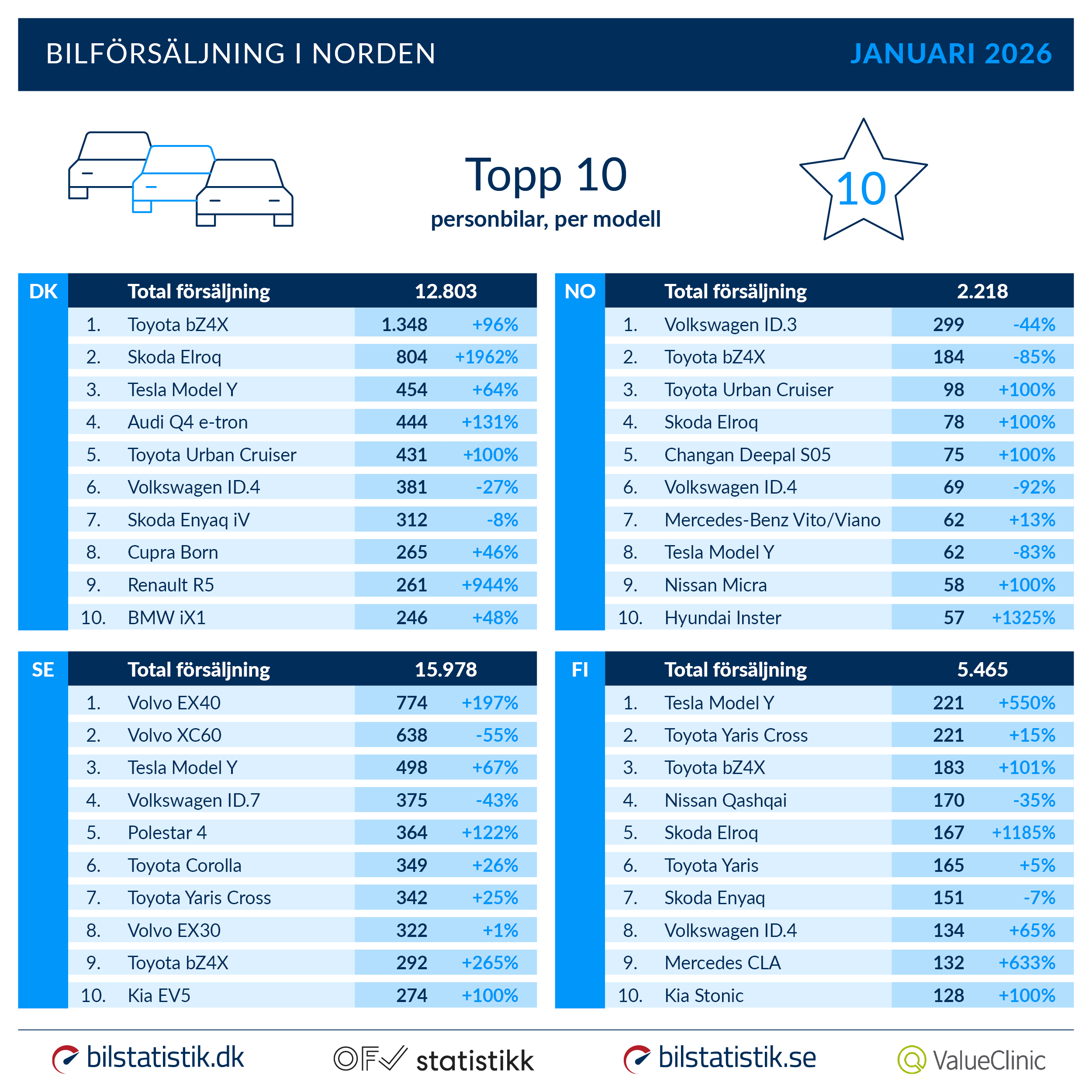
As usual we have difficulty agreeing on the favourites across the four Nordic markets. In Denmark the Toyota bZ4X finished first, in Norway it was the Volkswagen ID.3, in Sweden the Volvo EX40 and in Finland first place went to the Tesla Model Y.
Among the 40 places on the four countries' top 10 lists, as many as 27 models are represented, and only two models recur on all four lists – the Tesla Model Y and the Toyota bZ4X. One of the more marked changes we see among the otherwise hybrid-loving Finns, where electric cars increasingly take the top 10 places. In addition, January welcomes a Chinese car that has never before reached the Nordic top lists: Changan, which with the Deepal S05 takes fifth place in Norway.
Good registration month for trucks – but weak for light trucks
January was no big month for light trucks. In Denmark there was a modest increase of 3%, and the month ended at 1,870 newly registered light trucks. It looked worse in the other three markets. In Sweden it got off lightly with a fall of 6.2%. In Norway and Finland one had to look a little further for the new registrations, with declines of 30.9% and 25.6% respectively compared with January last year.
It looked better for the heavier vehicles – trucks. Here it is Sweden that, with a total of 359 new registrations corresponding to a decline of 17.7%, can look back on the weakest month. In Finland, Denmark and Norway the results land at passable levels with increases of 10.3%, 10.4% and 35.8% respectively.
Sharing the content of the article
Figures and data from the article may only be shared with a clear reference to the source:
Danish data: Bilstatistik.dk
Swedish data: Bilstatistik.se
Norwegian data: Opplysningsrådet for veitrafikken
Finnish data: Value Clinic (Finnish Transport and Communications Agency Traficom, Transport and Traffic Register)